
Our research
CFD renewables
Computational Fluid Dynamics (CFD) methods are used in many industries as design and optimisation tools. Manchester is world leading in both CFD and Turbulence modelling. An objective of ongoing research is to develop CFD for design and optimisation of tidal stream turbines.
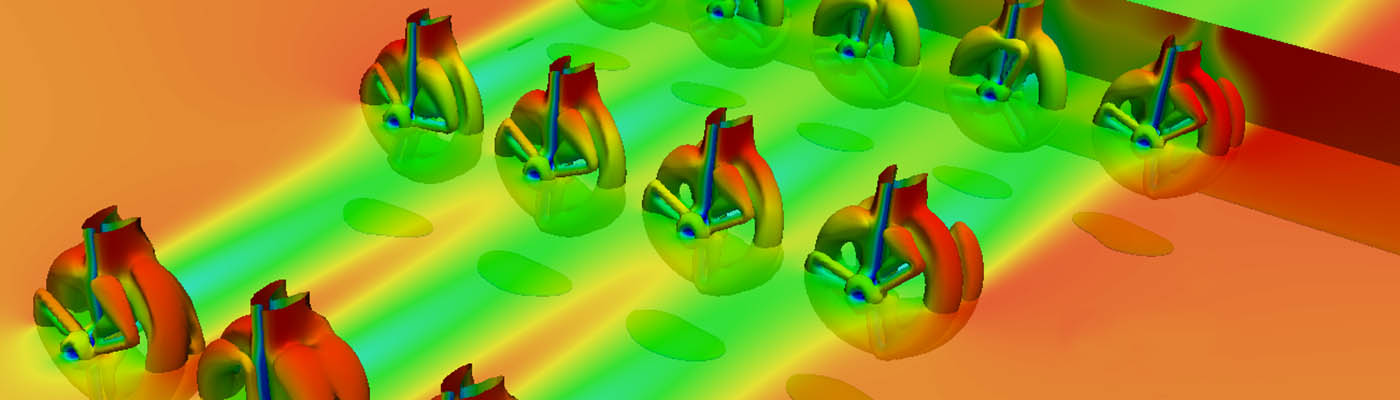
Existing open source codes have been further developed to simulate the loading of tidal stream turbines due to large-scale turbulence and waves. Ongoing numerical work involves resolving the rotor of a rotating three-bladed turbine, modelling combined current and wave loading and simulating large scale turbulence beneath a free surface to represent measured conditions at a tidal stream deployment site. These massively parallel simulations are conducted using CODE_SATURNE.
A range of numerical models are also employed to analyse specific problems smooth particle hydrodynamics (SPH) has been developed to simulate response of devices to extreme wave loading, and linear wave theory (WAMITTM) and spectral wave models (SWAN) employed to study the response and energy yield of arrays of devices.
This research is currently funded by EDF, the Energy Technologies Institute and the EPSRC. Field trials are ongoing as part of the ReDAPT project to evaluate the accuracy of massively parallel CFD for prediction of unsteady loads.
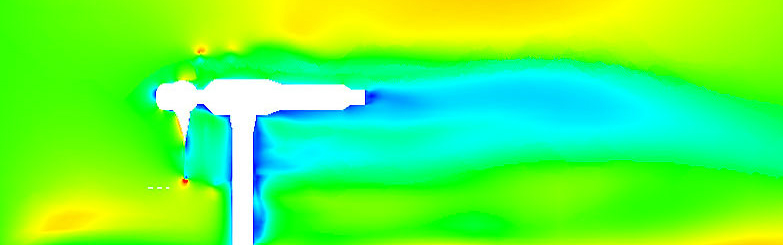
RANS CFD of the wake of a tidal stream turbine
Offshore wind
Manufacture, deployment and operation of wind turbines is now a major industry sector. More than 6 GW of wind turbines are now installed in the UK and these generate more than 4% of UK electricity demand.
Sites have now been identified for more than 28 GW of additional capacity so that wind turbines will generate more than 20% of present demand. Improvements in turbine design and support structure design are crucial to maintain cost-effective deployments, particularly in deep water.
Research focus
Research within this specialism looks at:
- the use of composite materials for turbine blades.
- structures for deep-water deployment.
- loading due to upstream wakes and the influence of atmospheric turbulence on unsteady loads and turbine performance.
- the magnitude of breaking wave loads on supporting structures.
Tidal stream turbines
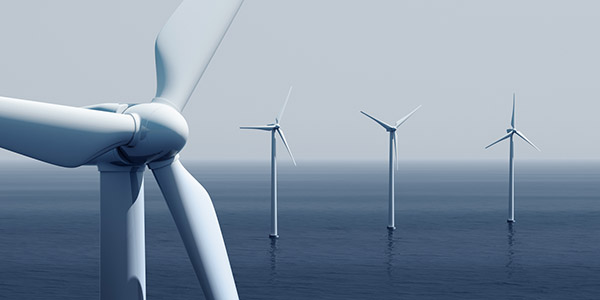
Tidal stream devices typically comprise a turbine to generate electricity from bidirectional flows with average velocities greater than 2 m/s. Farms of these devices deployed at key sites around the UK could generate 5-10% of present UK electricity demand. Some tidal stream devices are based on the configuration of a wind turbine, comprising two or three blades rotating around an axis parallel to the flow. However, the presence of large-scale turbulence within the flow and a free surface above the device that may be subject to wave forcing present very different design problems to wind turbines.
Research focus
- Energy yield from farms comprising multiple turbines
- Loading of turbines within arrays
- Influence of waves and turbulence on mean and unsteady loads
- Extreme loading due to waves, turbulence and impact by debris or vertebrates
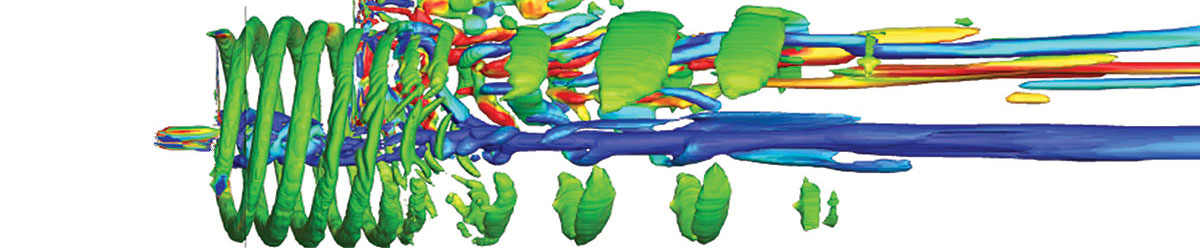
Modelling of turbulence around a tidal-stream turbine
Wave energy systems
Wave devices typically comprise one or more floating bodies whose oscillation drives an electric generator. Recent estimates suggest that more than 12% of UK electricity demand could be generated from such devices deployed around the UK.
To realize this potential, commercial-scale projects are expected to comprise large numbers of individual devices deployed in arrays, typically in water depths of 50 m and greater. Devices must be designed to generate electricity from average wave heights of around 1-2 m but must also resist damage during extremely severe individual waves that are an order of magnitude larger.
At present a handful of such systems are undergoing prototype trials at offshore test centres such as the European Marine Energy Centre (EMEC).
Research focus
- Influence of hydrodynamic interactions on response and energy yield of devices in arrays.
- Wave field modificiation due to energy extraction
- Response and loading of devices due to extremely severe waves
- Evaluation of device concepts
Research methods
Manchester has conducted detailed experimental studies of response of individual devices to extreme waves and interactions amongst arrays of devices.
Numerical methods employed range from linear wave theory (often by the commercial code WAMIT) through to Smooth Particle Hydrodynamics (SPH) which has been developed to simulate floating body response to focused waves.
Opportunities
Find opportunities to research Offshore Renewable Energy and how to apply.
Meet the team
Details and contacts for our academic staff, research associates and PhDs.
Contact Us
+44 (0) 161 306 6000
Connect With Us