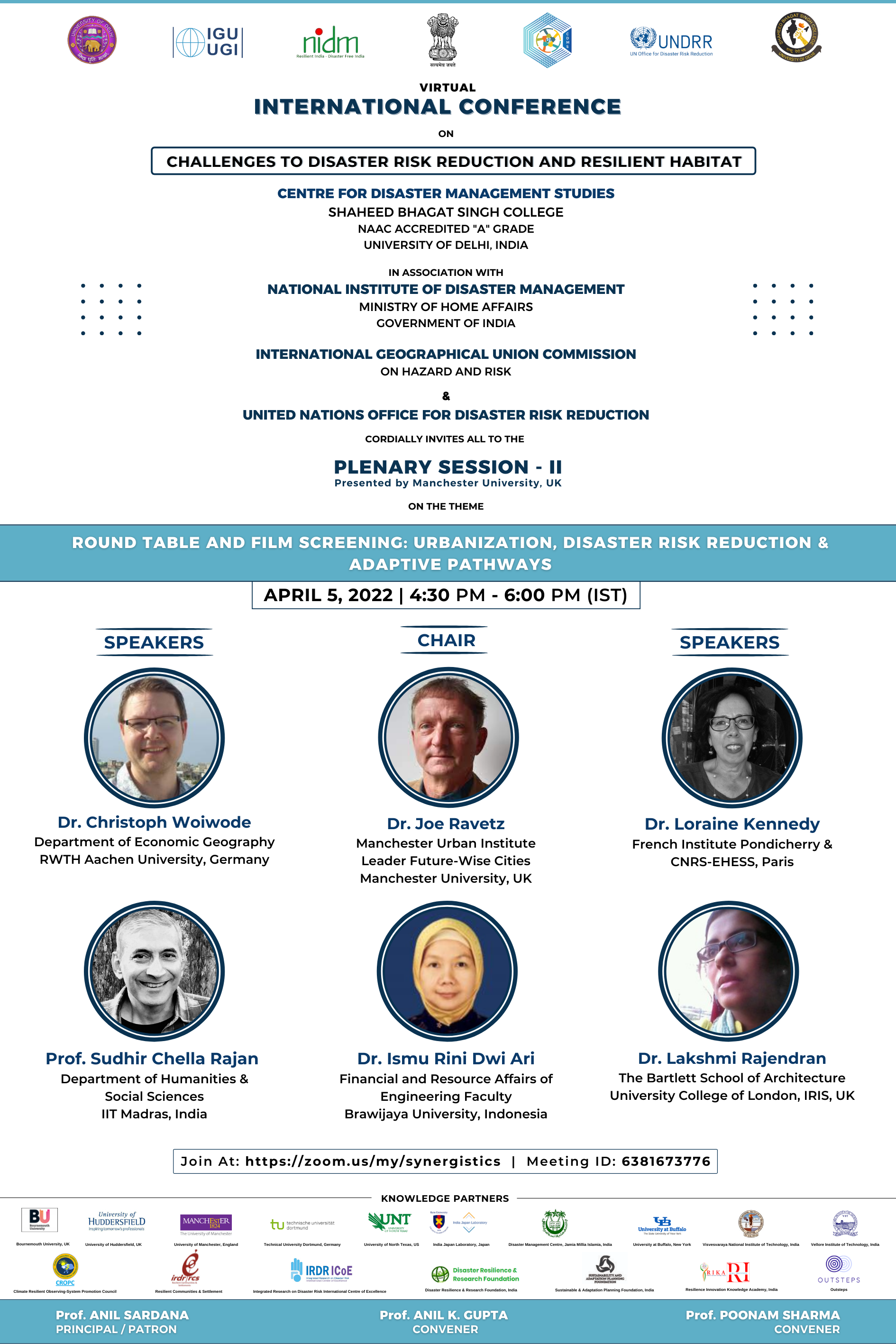
PERI-CENE: FILM SCREENING & ROUND TABLE:
‘Urbanization, Disaster Risk Reduction & Adaptive Pathways: Chennai in global context’
As the human population increases, so does the pressure for urbanization…. Around the world, metropolitan regions are haphazardly “sprawling” past their effective borders and into the sub-optimal peri-urban areas. The planet has entered the ‘Peri-cene’ phase – a new global human-environment system shaped by peri-urbanization.
The Indian city of Chennai shows many challenges, with a combination of climate risk, socio-economic divisions and disruptions, and sub-optimal governance. Here the Indo-German Centre for Sustainability (IGCS) at IIT Madras has focused on three critical areas – water, land use, and governance – in collaboration with the University of Manchester and KTH Royal Institute of Technology (Stockholm) on the global project Peri-cene.
Around the world peri-urban settlements suffer the impacts of climate-driven weather extremes – cyclones in South East Asia, wildfires in Australia, riverine flooding in China. On the positive side, there are many examples of peri-urban resilience, via novice solutions or “adaptive pathways”, with transformational agro-ecology, natural flood management or eco-tourism. With peri-urban land areas around the world now doubling every 24 years, there is an urgent need to steer the peri-urban towards resilience and sustainability. But this raises challenges both for science and for policy…
- Link to join – https://zoom.us/my/synergistics
- This film is based on research at https://www.igcs-chennai.org/ –
- with partners in UK and Sweden, on the global project http://peri-cene.net
- with invitation to join the Peri-urban Initiative – https://periurban.iitm.ac.in/
- with thanks for hosting at the CDMS conference – https://cdmssbsc.org/international-conference.php
Program:
4.35: Introduction & global context: disaster management in the ‘peri-eco-urban anthropocene’ (chair: Joe Ravetz, University of Manchester)
4.40: Introduction to the film & the Peri-urban Initiative (Christoph Woiwode, IGCS, IITM)
4.45: Screening: Chennai – a global south metropolis in the global peri-cene
5.20: panel responses: Dr Loraine Kennedy, French Institute Pondicherry: Prof. Ismu Rini Dwi Ari, University of Brawijaya: Dr Lakshmi Ragajendran, University College London:
5.35: open discussion – challenges & ways forward
5.55: wrapping up & next steps: (Prof. Chella Rajan, IGCS, IITM Chennai).
The film is also available on “Chennai – A Global South Metropolis in the Peri-Cene”
Any queries & comments: joe.ravetz@manchester.ac.uk