
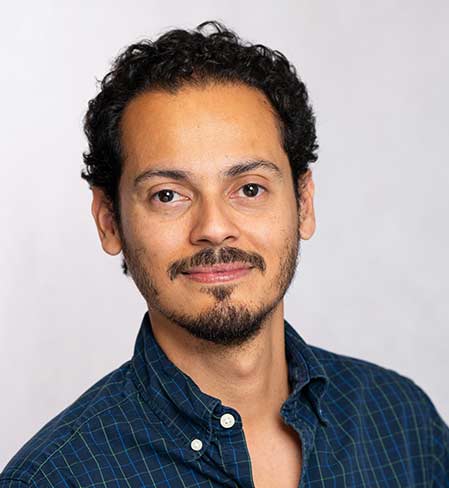
Dr Eder Zavala
Eder Zavala is a UKRI Future Leaders Fellow and Senior Lecturer in Mathematical Biomedicine. His research combines mathematical modelling, high-resolution physiological measurements and wearable technologies to understand how biological rhythms are generated, how they vary between individuals, and how their disruption contributes to disease.
 What does your research group study?
My group studies the mathematics of human physiology, with a particular interest in biological rhythms.
Many important physiological signals are dynamic. Hormones, for example, are not simply present at a particular concentration: they fluctuate over minutes, hours and days. These rhythms carry information and help different parts of the body coordinate their activity. When those patterns are disrupted, this can be associated with disease.
We develop mathematical and computational models to understand how these rhythms are generated and regulated. A major focus of our work is the endocrine system, particularly the hypothalamic-pituitary-adrenal (HPA) axis and hormones such as cortisol. We are interested in how feedback loops generate ultradian and circadian rhythms, how these rhythms differ between people, and what happens when the underlying regulatory mechanisms are disrupted.
Ultimately, we want to understand not just how much of a physiological signal is present, but when it occurs, how it changes over time, and what those dynamics can tell us about health. This naturally requires working across disciplines and biological scales, connecting mathematical models of underlying mechanisms with experimental, clinical and real-world measurements of human physiology.
What are you working on at the moment?
An important direction for us is bringing mathematical models closer to measurements of human physiology in everyday life.
Traditionally, many hormones are measured using a single blood sample taken in a clinic. But a snapshot can miss much of the information contained in a dynamic biological signal. We are therefore working with technologies that allow us to measure physiology much more frequently, including ambulatory sampling of hormones in interstitial fluid and wearable sensors measuring variables such as glucose, activity, sleep, heart rate and temperature.
We then combine these measurements with mathematical models and time-series analysis to identify biological rhythms and understand the mechanisms generating them.
One of the questions that particularly interests me and my group is how different biological clocks and physiological systems interact. Sleep, endocrine rhythms, metabolism and immune function all influence one another, but they are often studied separately. By bringing together mathematical, experimental and clinical perspectives, we hope to understand these interactions as part of a connected physiological system. This may help us identify when biological timing has become disrupted and, eventually, how it might be restored.
How did you become interested in biological timing?
My route into the field has been quite interdisciplinary. I originally trained as a physicist in Mexico and later moved towards biomedical engineering and molecular biomedicine.
What attracted me to mathematical biology was the idea that we could use equations to understand something as complex as human physiology. Biological systems contain feedback, delays, oscillations and interactions across many different timescales, exactly the kinds of phenomena that mathematicians and physicists have studied for a long time.
My interest in biological timing developed through studying endocrine systems. Hormone rhythms provide a particularly striking example of why dynamics matter in biology: the same hormone can have very different effects depending on its temporal pattern.
Since then, my research has increasingly moved towards combining mathematical theory with experimental and clinical data, particularly high-resolution measurements collected from people over extended periods of time. Biological timing is inherently interdisciplinary, and I find the interface between mathematics, experimental biology, technology and medicine particularly exciting.
Why is mathematical modelling useful for studying biological rhythms?
Experiments can tell us what happens, but mathematical models can help us ask why it happens.
For example, if we observe cortisol oscillating every hour or so, we can build models representing the feedback interactions between the hypothalamus, pituitary and adrenal glands and ask which mechanisms are sufficient to generate those oscillations. We can then perturb the model, compare its predictions with experimental data, and investigate what might change in disease.
Models also allow us to connect processes operating at different timescales. In endocrine systems, fast ultradian oscillations occur on top of slower circadian rhythms, while sleep, behaviour and environmental signals provide additional inputs.
I see mathematical models as a bridge between biological mechanism and complex physiological data. Increasingly, they can also help us interpret the enormous amount of longitudinal information generated by wearable and ambulatory sensing technologies. This provides an opportunity to connect processes ranging from the mechanisms that generate biological rhythms to the patterns we can measure in people going about their everyday lives.
What have been the highlights of your research so far?
One of the most rewarding aspects of my work has been seeing mathematical predictions connect with new ways of measuring human physiology.
For example, we have developed mathematical models to investigate how feedback within the HPA axis generates the pulsatile patterns of cortisol that we observe throughout the day. This work helped show how relatively simple regulatory mechanisms can generate complex hormone dynamics, and how mathematical models can be used to explore aspects of endocrine physiology that are difficult to investigate experimentally.
Another major highlight has been my involvement in the Horizon 2020 ULTRADIAN project and the development of U-RHYTHM, a technology that allows hormones to be measured automatically from interstitial fluid over extended periods while people go about their normal daily lives. Combining these high-resolution measurements with mathematical and computational approaches has allowed us to begin studying endocrine rhythms outside the highly controlled environment of the laboratory or clinic.
More recently, I have been excited by the opportunity to integrate these hormone measurements with data from wearable devices. This brings together several strands of our research, mathematical modelling, endocrine dynamics, biological timing and digital health, and opens the possibility of studying how hormonal rhythms interact with sleep, metabolism, activity and other aspects of physiology in real-world settings.
Perhaps the biggest highlight, however, has been seeing this work become increasingly interdisciplinary. Collaborating with mathematicians, engineers, experimental scientists, clinicians and people living with endocrine conditions has changed the questions we ask and the way we approach them. For me, that interaction between mathematical ideas, new technologies and human physiology is where some of the most exciting opportunities now lie.
What do you hope this research will ultimately achieve?
One of our long-term goals is to contribute to a more dynamic and personalised view of medicine.
People differ substantially in their physiological rhythms, so a measurement that is considered unusual at one time of day may be perfectly normal at another, and a pattern that is normal for one person may not necessarily be normal for someone else.
By combining mechanistic models with longitudinal measurements, we hope to identify meaningful changes in an individual’s physiology rather than relying exclusively on population averages and isolated measurements.
Ultimately, I would like this work to help bridge the gap between our understanding of the mechanisms that generate biological rhythms and how we measure and treat people in the clinic. This could contribute to new approaches in digital endocrinology and chronomedicine, helping us determine not only whether physiology is disrupted, but how it is disrupted, and potentially when an intervention might be most effective.
Find out more about the Mathematical Biomedicine Group:
Related
Contact Us
+44 (0) 161 306 6000


0 Comments