
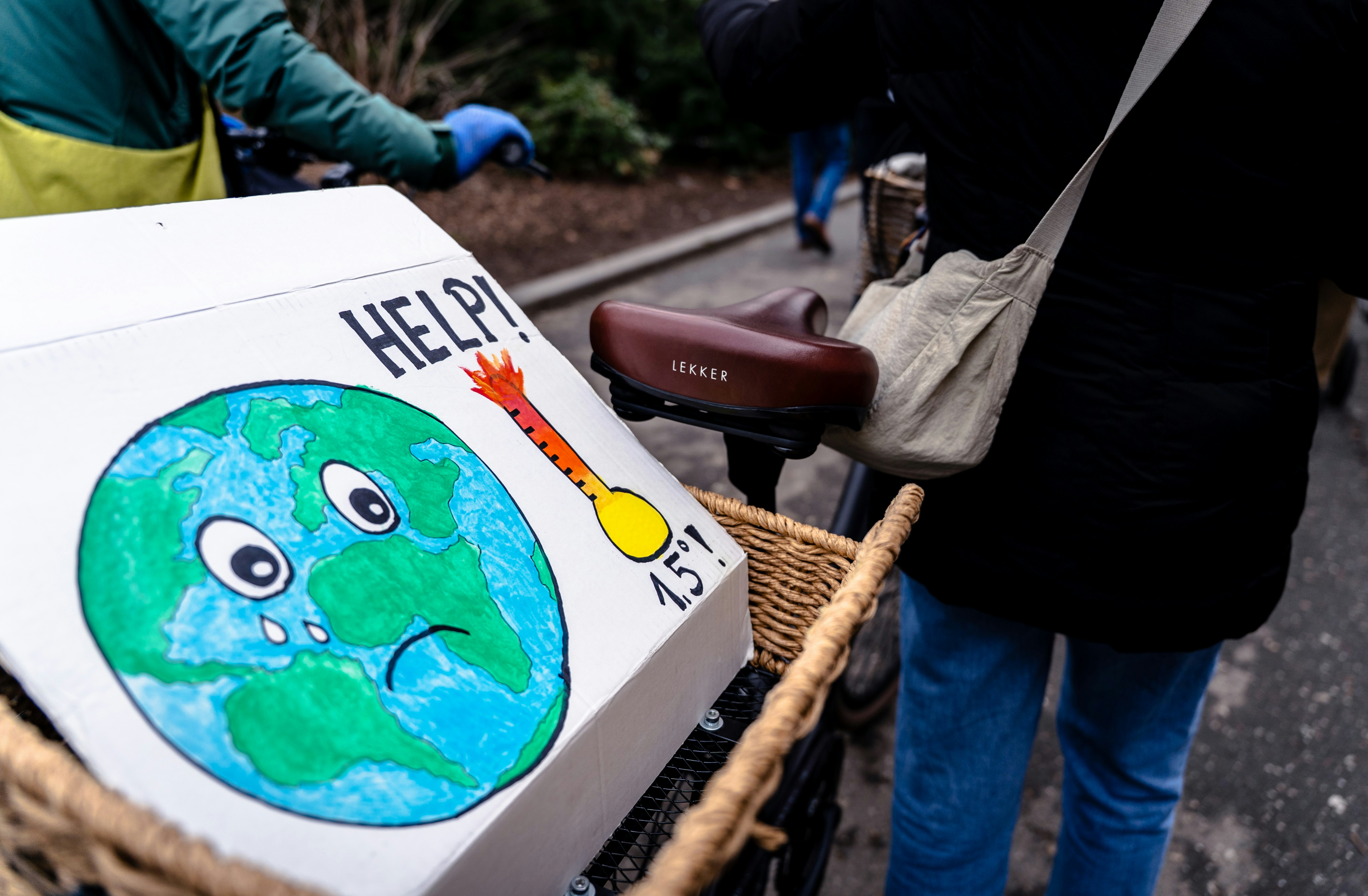
Climate change and capitalism: One world, why go beyond critical threshold?
Article by Amelia Horn
Photo by Mika Baumeister on Unsplash
Climate change and global warming are two globally known topics of discussion, acknowledged, but feared. Human-driven climate change is severely altering the biological systems that sustain life on earth. (Oxford university press, 2015). Global temperatures have risen over the past century by at least 0.74°C, which was induced consequently by higher excretion of greenhouse gases, which us humans burn and release (John Urry , 2009 ). The high levels of greed and the constant cycle of wanting more is detrimental to future life on earth. Human societies are shown to have an ‘intimate interdependency’ with their ecological contexts and how alternating the natural systems of the world with global warming will constantly present serious risks, but who endures these repercussions highlights the ever-going inequality in society (Brett Clark , 2005) but it is up to humans as one to break our cycle to mend and repair earths equilibrium.
Unequal effects of the phenomenon:
According to World Health Organisation (WHO, 2014 ) quantitative risk assessment (2014), And updated fact sheet (2023), climate change is associated with 150,000 deaths annually and historically, and is projected to cause 250,000 additional deaths per year (2030-250). However there is clear disparity in where the deaths occurred(John Urry , 2009 ). At the receiving end of most inequality is the ‘global south’. Countries in the underdeveloped category, while facing challenges of their own, are now seen to suffer the consequences of bourgeoise gluttony. The main contributors to climate change are significantly shown to be the wealthy, global north. With their wealth and riches, pumping out these emissions into the same atmosphere the rest breathe, has clear unjust. During Cop27 Chad, Somalia and Syria where labelled the most vulnerable to the concequences of up and coming environmental issues. With global warming inducing climate issues like: famine, drought, flooding, statistically countries with lower economic stability, are undoubtedly more effected (Iberdrola, 2025). However due to the shear increase in ecological issues, they are now faced by all life on earth, even the elite.
Facing what they created, bourgeoise backlash:
With the emergence of industrialisation there has always been a divide In wealth. Defined as the bourgeoise, typically with references to its perceived materialistic value who own most of society’s wealth, the means of production are constantly growing in the hands of this wealthy group (Oxford languages , 2025). On the other end is the proletariat, the working class people who are the wage earners (Oxford languages , 2025 ). After decades of consumerism charged by e.g. capitalist marketing and changing trends, targeted towards the rest of society, as Urry (2010) argues, late‑century capitalism normalised high‑carbon ‘consumptions of excess’ which had significance to the high carbon consumption of the ‘global north’ at the end of the 20th century and at the beginning of the 21st. With this, we start to see problems once faced by the poor infiltrate the rich, as with the consequences of global warming (John Urry , 2009).
As earth has known to have finite resources, which the wealth in hand used to have power over, there is now Increasing conflicts over said resources, even intersectionality within the affluent spheres. Global warming, which was kick started by the wealthy, has accelerated the decline in the resources. Most used resource, which is commonly overlooked to be in astronomical decline by media, fresh potable water. With contested water sources in the affluent country of Australia, we see the strain global warming and climate change is having to this $15 trillion GDP country (Cait Kelly , 2023). The Murray darling basin covers 1 million km2 of south east Australia and is home to 2 million people. This basin is under threat from increasing and competing demand. Moreover the phenomenon of the ENSO cycles faced in Australia, this has mean rainfall has become irregular (Australian government , 2025). Other countries with elite high status facing the consequences of climate change is Canada, France, japan, the UK and the US, having to adapt to impacts like heatwaves and flooding (Tobias Bunde , 2022). However, it is seen these elite countries are more lenient to changing their ways and enforcing greener ways of living to reverse what is pushing the world beyond repair and is argued nations in the periphery remain major polluters and are unable to pursue more energy efficient paths of development, given that their economic development is bodied and indexed by debt export dependency (Brett Clark , 2005).
In conclusion, the world is changing and adapting to climate change and global warming, but the global urgency is lacking. Clear indicators of failure to change such as mass amounts of natural disasters, coral bleaching, endangering of species etc.. and the greed of the wealthy has documented prolific loss for our world. Nearing closer to critical threshold, we do appreciate the contributions of thousands in making it right, but the help of everyone is needed, so backing out of environmental agreements and turning eyes from greener ways isn’t acceptable.
Bibliography:
- Oxford university press. 2015. Climate change and society . 1 ed. Oxford university press, incorporated . https://ebookcentral-proquest-com.manchester.idm.oclc.org/lib/manchester/detail.action?docID=3564729
- Urry J. 2009/10 . Sociology and climate change: ‘consuming the planet to excess’. Emerald . https://journals-sagepub-com.manchester.idm.oclc.org/doi/pdf/10.1111/j.1467-954X.2010.01887.x
- Clark B & York R . 2005 . Carbon metabolism: global capitalism, climate change and the biosphere rift . Theory and society 34: 38. https://www-jstor-org.manchester.idm.oclc.org/stable/4501730?seq=1
- WHO (2014). Quantitative risk assessment of the effects of climate change on selected causes of death, 2030s and 2050s.
- WHO (2023). Climate change and health – fact sheet
- 2025. Which countries are most threatened by and vulnerable to climate change? (Cop 27 overview) https://www.iberdrola.com/sustainability/top-countries-most-affected-by-climate-change#:~:text=Due%20to%20drought%20and%20political,Central%20African%20Republic
- Oxford languages . 2025 . Oxford languages . Oxford Languages . https://languages.oup.com/google-dictionary-en/
- Kelly C . 2023 . Australia’s wealthiest 20% worth 90 times the county’s poorest, new report reveals. . Accessed: 9th October 2025 from: https://www.theguardian.com/australia-news/2023/sep/27/australias-wealthiest-20-worth-90-times-the-countrys-poorest-new-report-reveals#:~:text=Australia’s%20wealthiest%2020%25%20worth%2090,of%2Dliving%20crisis%20%7C%20The%20Guardian
- Australian government . 2025 . Murray-Darling basin . Accessed: 9th October 2025 from: https://www.dcceew.gov.au/water/policy/mdb
- Bunde T & Eisentraut S. 2022. Turning the tide, unlearning helplessness. Munich security report 2022 https://securityconference.org/assets/02_Dokumente/01_Publikationen/MunichSecurityReport_2022_TurningTheTide.pdf
Contact us
+44 (0) 161 306 6000


0 Comments