
Walking the Hidden Histories of Ardwick’s Women
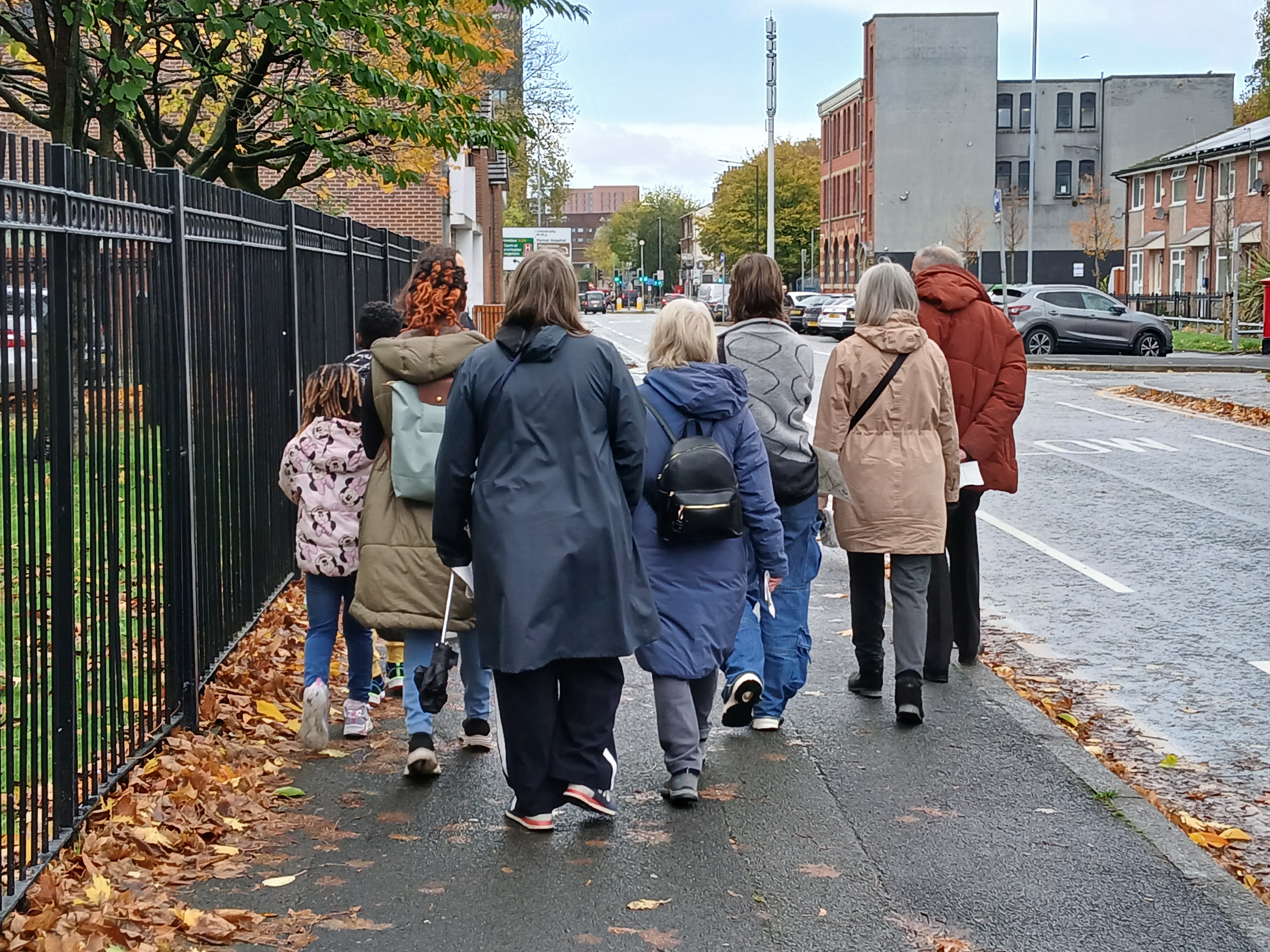
On Monday 27th October, about 20 people gathered on Wadeson Street in Ardwick to take a walk – but not just any walk. This was a walk through untold history, collective memory, and forgotten resistance.
The event marked a milestone in a grassroots research project that began with a simple question: Who was Ellen Wilkinson? Two University of Manchester researchers, working out of the Ellen Wilkinson Building, discovered she had been born less than a mile away. That local connection sparked something bigger.
Instead of stopping at a biography, the project grew into a collaborative effort with a local school, church, artists, activists, and extra care facility residents. Together, they asked: Who else from this area has been overlooked?
That question led to a walking route – Ellen’s birthplace to her namesake building at the university – winding through the Brunswick estate and the campus. It’s not just a path. It’s a way of seeing the city through the lives of women who have shaped, resisted, built, and fought from its margins.
Despite grey skies and a police cordon that briefly threatened to derail the event, the walk went ahead. Among the group: students, retirees, school children, office workers, and academics. Strangers connected by a desire to learn what history had buried.
As the group moved along the route, they heard stories – many for the first time – of women like Louise Da-Cacodia, Khiara Keating, Yomi Mambu, Sylvia Pankhurst, Dr Sylvia Sham, Altheda the Great, Megan Lloyd George, Lydia Becker, Ann Hunt, and Elizabeth Yarwood.
Names that don’t show up in schoolbooks or city plaques. Stories that never make the headlines. Yet each woman stood for something: health equity, political representation, anti-racism, education, safety, care. Their lives pointed to the injustices that persist in the area today: poverty, racial inequality, housing insecurity, pollution, and gender-based violence.
Residents on the walk admitted they had never heard of most of these women. And that’s the point. This walk isn’t about nostalgia – it’s about reclaiming what’s been erased.
In a city where development often outpaces remembrance, this route plants markers of community knowledge and resistance. It invites us to see Ardwick not as a place “left behind,” but as a site of struggle, activism, and power.
It also shows what universities can be when they listen. This isn’t research extracted from the community; it’s co-created, grounded in lived experience, and driven by a desire for justice.
A downloadable map will soon be available, turning this pilot into something permanent. A route for future walkers, school groups, and curious minds to follow. A tool for learning, remembering, and continuing the fight.
Because these women don’t just belong to the past. Their stories still echo. And their battles aren’t over.
As one participant said at the end of the walk:
“I’ve lived here all my life, and I never knew half of this. These women deserve to be remembered.”
We couldn’t agree more.
Written by Dr Carl Emery and Dr Sandra Clare
Walking the Hidden Histories of Ardwick’s Women was part of the ESRC Festival of Social Science 2025 and was made possible thanks to funding from the Economic and Social Research Council (ESRC), which is part of UK Research and Innovation (UKRI). The UKRI Economic and Social Research Council (ESRC) is part of UK Research and Innovation (UKRI), a non-departmental public body funded by a grant-in-aid from the UK government. It funds world-leading research, data and post-graduate training in the economic, behavioural, social and data sciences to understand people and the world around us.
Contact Us
+44 (0) 161 306 6000


0 Comments