
From Commuting Student to Assistant Curator: My Museum Career Journey
My current role and how I got here
I am an Assistant Curator at the Museum of Liverpool, and I work with Archaeology and Social History collections.
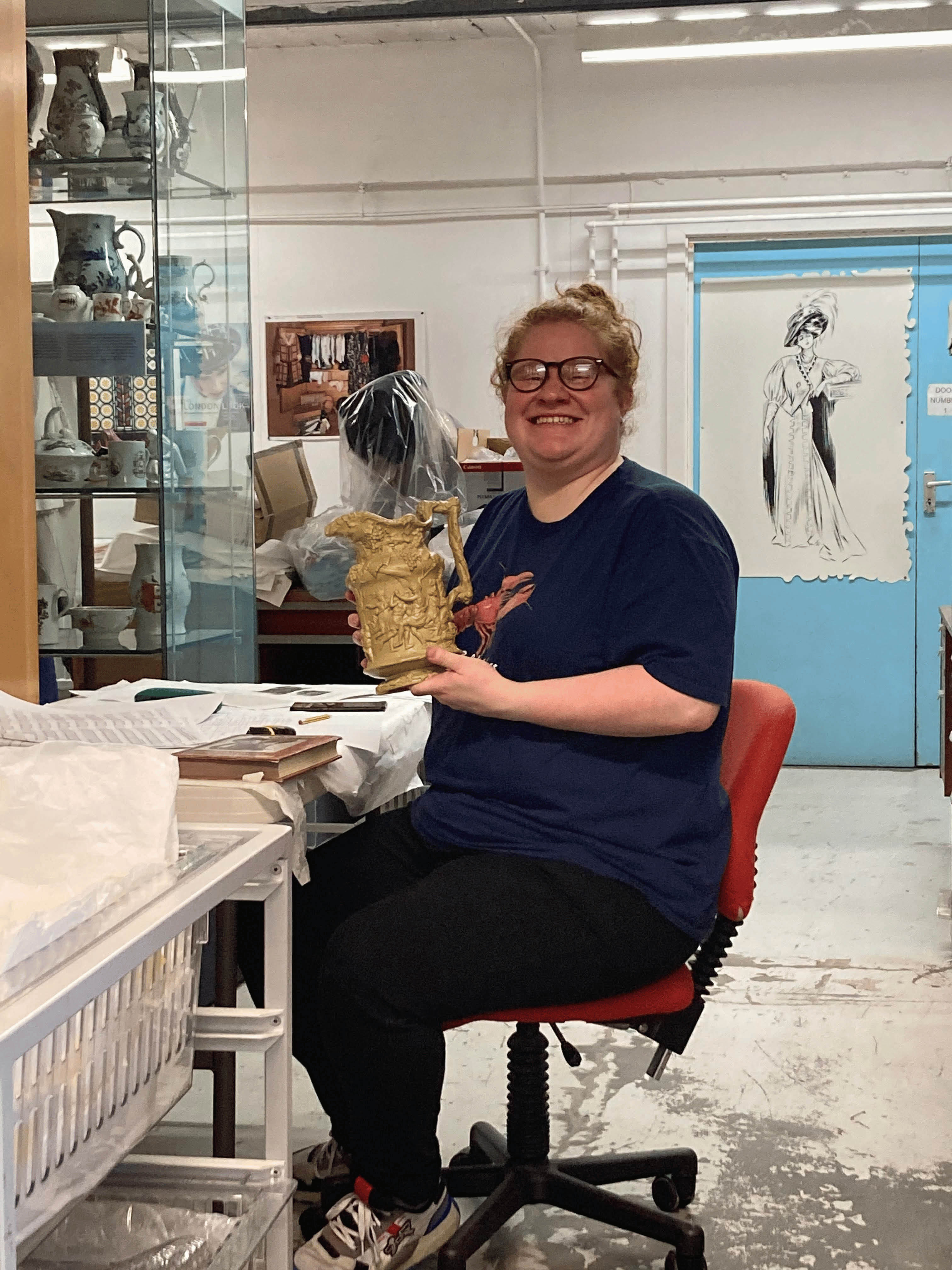
In my role I care for all the weird and wonderful objects that make up the Museum of Liverpool – from fire engines to Mesolithic dog footprints, through to Speedo Mick’s underwear.
I work with collections behind the scenes, making sure they’re well-documented, we know where they are, and they’re easily accessible. I then help to bring these objects and their stories to life for visitors by creating displays, updating permanent galleries, and assisting with temporary exhibition research. I also monitor objects’ environmental conditions while they’re on display in the museum using different conservation tools (humidifiers, pest traps, light monitors). Working in a local history museum means the communities that visit your venue should be at the centre of the work you do, so, I also work on community engagement projects. I have led talks for young people who are interested in the sector, delivered workshops about curatorial skills, and ran on-gallery handling tables for visitors.
When I finished my undergraduate degree in Philosophy, I didn’t really know what I wanted to do and got a weekend job working at World Museum, Liverpool, as a Visitor Assistant. I’d worked as a bouncer during my undergrad and was surprised at the amount of similarities between dealing with drunk students and working with families of four, desperate to see dinosaurs!
Through work I was given the opportunity to volunteer with different departments at National Museums Liverpool, such as the Digital Production team, the Global Cultures curators and finally the Decorative Arts department as part of my MA placement. Thanks to these experiences I realised I wanted to work in the museum sector, specifically with objects. I still find it baffling to this day that I’m working with material that’s, in some cases, thousands of years old.
My experience at Manchester
While still working as a Visitor Assistant, I applied for the MA in Art Gallery and Museum Studies at Manchester. I had the practical experience of the sector thanks to work, but wanted to know more about the theoretical parts of museum work.
As I was working in Liverpool, I commuted into Manchester. Despite the 58-minute distance, countless delayed trains, and 6 am wake ups, I was able to have a full experience at the university (which meant the odd couch-surfing evening post-quiz at the students’ union). The university also has a Commuter Students support group and a Commuters Society, so there’s plenty of support if you decide not to live on campus.
How my degree helped me
The Art Gallery and Museum Studies MA really sets you up for work in the museum sector, and several of my colleagues also studied at Manchester and now work in a variety of departments, such as education and administration.
I absolutely loved the mix of practical and theoretical classes offered, especially the opportunity to create our own exhibition as a group. We also had several guest lectures from professionals working across the sector which gave us an idea of all the different roles out there.
On top of this, having a placement module meant students were able to get a great grounding in the realities of day-to-day museum work. I was lucky enough to do mine with the Decorative Arts department at National Museums Liverpool, and I learnt so much about documentation, database work, and developed a deep love of Toby Jugs.
The skills I learnt during the course and my placement, such as object wrapping, preventative conservation, and label writing, are ones I use every day as Assistant Curator.
Advice for future students
It sounds obvious but make sure you enjoy what you do! It can be tempting to rush into doing a postgraduate degree after you graduate, but take the time out to work and explore what you’re actually interested in. If you can, volunteer as much as possible before deciding on what to study.
Don’t be afraid to go to office hours and ask questions. No one wants you to feel out of your depth and it’s much less intimidating than it feels in your head. I found the lecturers in the Institute for Cultural Practices so friendly and approachable, and it really made a difference speaking with them when I was unsure about work (or when I changed my dissertation subject with a month to go!).
If you want to work in a curatorial or collections role after graduation, I’d highly recommend working front-of-house as well, not only does it open up opportunities like volunteering, but it also gives you a pretty good idea of what people want to see in museums and galleries.
Written by Ellie Shenton- MA Art Gallery and Museum Studies Graduate
Related
Contact Us
+44 (0) 161 306 6000


0 Comments