
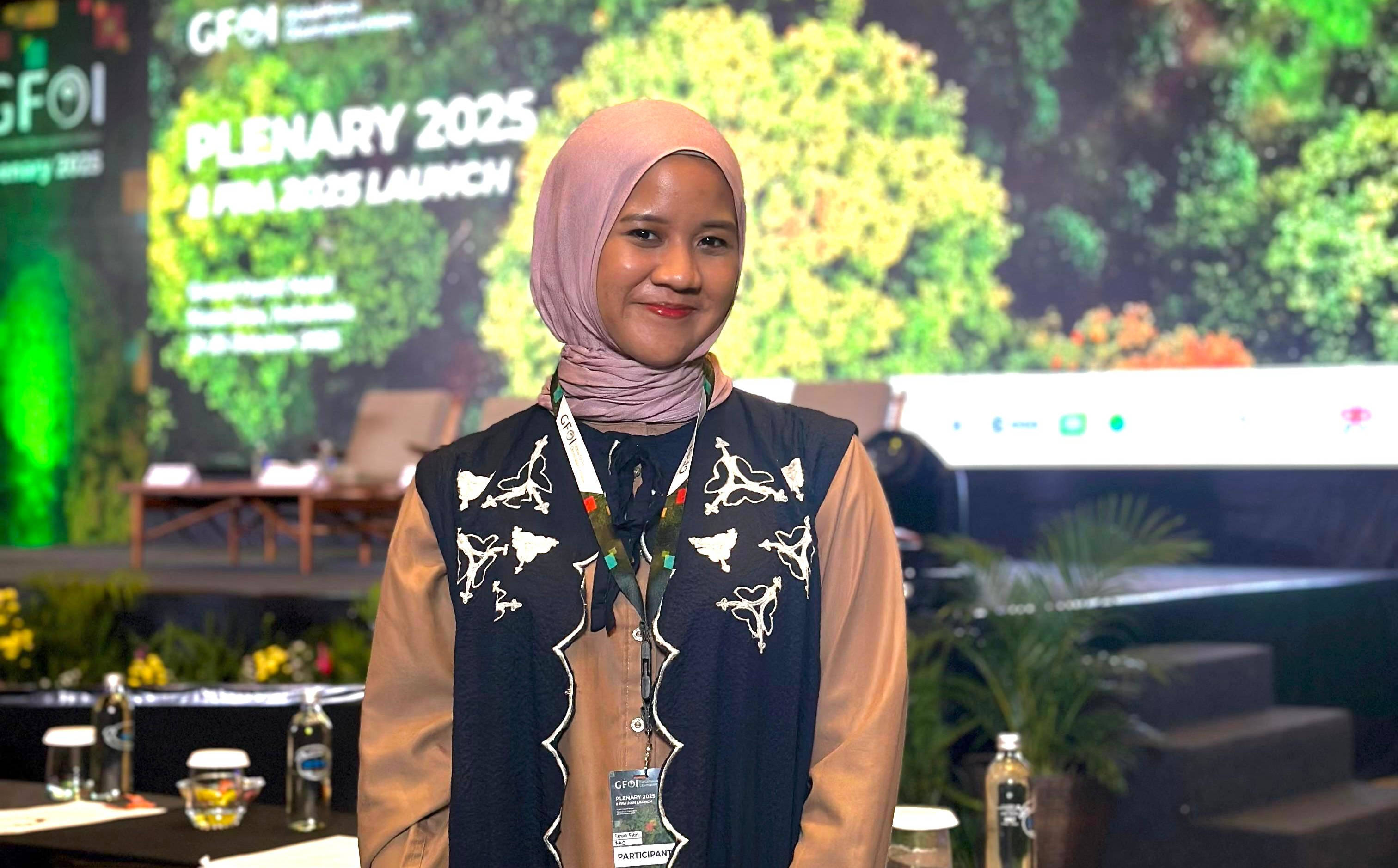
Alumni Profile – Sesia Fitri Anisa talks MSc Environmental Governance
About Sesia…
Sesia Fitri Anisa studied MSc Environmental Governance with the Geography Department at the School of Environment, Education and Development. She graduated from The University of Manchester in 2023.
She now works in the environmental field for a United Nations’ agency: the Food and Agriculture Organization (FAO).
The present – how does Sesia put her Environmental Governance degree into practice at the UN?
What is your current role and what does it involve?
I am a Forestry and Climate Change Specialist at FAO, working under the United Nations Programme on Reducing Emissions from Deforestation and Forest Degradation (UN-REDD). In particular, I work on the ASEAN Social Forestry Initiative. My work focuses on advancing climate change mitigation outcomes from social forestry across ASEAN Member States.
How did your master’s degree in Environmental Governance help prepare you for this role?
My degree in Environmental Governance strengthened my understanding of how policies are designed and implemented, and how environmental challenges are shaped by the interactions of different actors. It helped me see environmental outcomes depend on how actors negotiate power, coordinate across scales, and work within specific political and institutional contexts.
This perspective has been essential in understanding that environmental issues are not purely technical, but often deeply political.
My dissertation was on REDD+ initiatives in Indonesia. So, this gave me a practical foundation in forest and climate governance. And it has been rewarding to see how the questions I explored academically remain relevant in real-world settings.
The theories and analytical frameworks from my studies have helped me in navigating complex power dynamics and building governance that is responsive to local and regional contexts.
Are there any skills from your Environmental Governance degree that have proved especially helpful?
I have found the research and analytical training particularly useful. Conducting independent research, especially through my dissertation and essays, helped me develop structured thinking and critical analysis skills.
These are skills I continue to use in my work.
What moment from your work has most surprised you? Have there been any parts of your work in social forestry where you’ve really had to rise to the challenge?
In 2025, I had the opportunity to represent FAO as a speaker at the 28th ASEAN Senior Officials on Forestry (ASOF) meeting in Luang Prabang, Lao PDR.
It was my first time speaking at a high-level regional forum. At that event, I discussed the integration of Nature-based Solutions in social forestry.
Beyond the formal sessions, the event also involved a series of bilateral meetings with government officials and other partners. These sessions made the experience especially dynamic.
It was both daunting and exhilarating, and it pushed me well outside my comfort zone in a positive way.
The past – Sesia’s first steps in the forestry and climate field…
What was your career path like after graduating? How did it lead you to your current work with Food and Agriculture Organization of the United Nations?
After graduating, I began my career as a freelance consultant.
As a freelancer, I worked on impact assessments for a national-level environmental project. It was a project supporting Indigenous Peoples and Local Communities (IPLCs) to reduce deforestation and land degradation through biodiversity conservation and sustainable land management.
This role marked my first fieldwork experience! It took me to Banyuwangi and Tulungagung in East Java. There, I conducted interviews and facilitated focus group discussions with Adat communities and small-scale farmers.
Through this project, I built relationships with stakeholders across multiple levels. Many of these, in fact, are people I continue to engage with in my current work at FAO.
Are there any moments from your Environmental Governance degree that were especially influential? Did anything inspire you or help you see things in a new way?
One module left a lasting impression on me.
As part of that module, there was a walking tour around Manchester. Through that tour, we explored how energy, water, transport, and waste systems are embedded in the city’s everyday landscape. Often, those systems are present in ways we barely notice.
Seeing these infrastructures up close, as part of the city, helped drive home what cities are. It helped me understand cities not just as places, but as living systems. And that those systems are shaped by historical, political, and environmental choices.
Was the University of Manchester able to help you along that career path after you graduated?
Yes, I made use of the University’s Careers service, particularly CareerSet, when I was looking for roles. As an alumna, I was fortunate to still have access to the platform. I used that support to refine my cover letters and ensure they were well-tailored to specific job vacancies.
The future – using expertise to make a difference (and Sesia’s advice if you want to do the same)…
What are the next steps for your career? What do you hope do accomplish in the future?
I would like to stay engaged in analysis, policy dialogue, and on-the-ground work within the forest and climate field.
Over time, I hope to grow my expertise in forest and climate governance and contribute to the development of more inclusive climate policies.
What is one piece of advice you’d like to give to people looking to study Environmental Governance or work in the field? Is there anything you wish someone had told you during your studies?
Don’t be afraid to dream big! Especially if you’re interested in working in the development sector or intergovernmental organisations like the UN.
Start building your portfolio early in whatever ways are available to you. For example, through research projects, internships, volunteering, or fieldwork. These experiences add up more than you might expect.
Most importantly, stay curious and open to opportunities, even if they don’t look like the “perfect” fit at first.
The MSc in Environmental Governance is taught by the Geography Department at Manchester’s School of Environment, Education and Development. You can find out more about what it’s like to be an Environmental Governance student on the Geography Student Stories page.
Related
Contact Us
+44 (0) 161 306 6000


0 Comments