
What My Time in Rwanda Taught Me about Law, Business and Community
Before arriving in Rwanda, I told myself that if I arrived with any preconceptions, assumptions or stereotypes about how Rwandan people live culturally or socially, it would only make the experience harder. So, I decided to go to Rwanda with a blank slate and an open mind.
After a delayed overnight flight, a long bus journey and the first of many bucket showers, Rwanda still felt very foreign to someone who had barely been outside of the UK. Most people would have understood if I’d felt nervous or anxious, but I mostly felt excited to throw myself into something so far outside anything I’d experienced before.
Despite the language barriers and cultural differences, we were welcomed warmly by the staff at Azizi Life. Between the repeated mispronunciation of our names and our attempts to say “hello” in Kinyarwanda, there was plenty of laughter from the very beginning.
Working with a social enterprise in Rwanda
On the Business Enterprise team, we looked at how Azizi Life could improve its day-to-day operations. We also built a marketing schedule for the café, the “Handcrafted Hotel”, the experience day packages and the cultural activities.
From the first day, we realised we would have the most real impact by focusing on small, practical changes rather than projects that might only come to fruition years later.
One example I worked on was marketing the café. A big issue we noticed was that the café was almost invisible. When we asked locals whether they knew there was a café nearby, they had no idea.
A simple fix that Azizi Life could put in place quickly was an individual sign by the roadside. I designed template signs, compared my designs with a working example from a competitor and went out to get a quote for installation.
In the grand scheme of things, it was a small task, but it was a practical one that could have a lasting impact. That was our whole aim: making a positive impact that continues after us.
What living with 21 volunteers taught me
Sharing a space wasn’t completely new to me because I share a room with my younger brother, but 21 people was a big step up.
We didn’t just work together. We slept, ate, played games, laughed and struggled together too.
The main thing I learned about myself, or at least strengthened, was my ability to adapt and compromise. With 21 people from very diverse backgrounds, all raised with different domestic norms, it was inevitable that someone would do something another person found annoying or disrespectful.
I learned quickly to say what I thought and needed while also trying to understand other people so we could find a middle ground. One month isn’t a long time, and holding grudges over small things would have only been detrimental to the whole group’s morale. That’s why I focused mainly on building good relationships with everyone.
One example of this was when I stayed up until 3am and, when I was heading back to my room, one of the boys had locked the room from the inside, leaving me outside in the living room and forcing me to sleep on the couch. Instead of banging on the door and waking everyone up, or making a scene the next morning, I laughed it off and it became a funny story at breakfast.
Living with the Rwandan volunteers came with some challenges, mainly around language and things getting lost in translation, but overall, it was a brilliant experience. We came from such different lifestyles, and we ended up connecting over those differences. We would talk for hours, sometimes laughing and sometimes just being curious about each other’s lives.
Some of the Rwandan and Manchester volunteers would go on early morning runs together, play basketball and football, and even do calisthenics and yoga together, which brought us even closer.
Meeting women artisans and experiencing community life in Rwanda
One of the first things we did was an experience day in one of the villages.
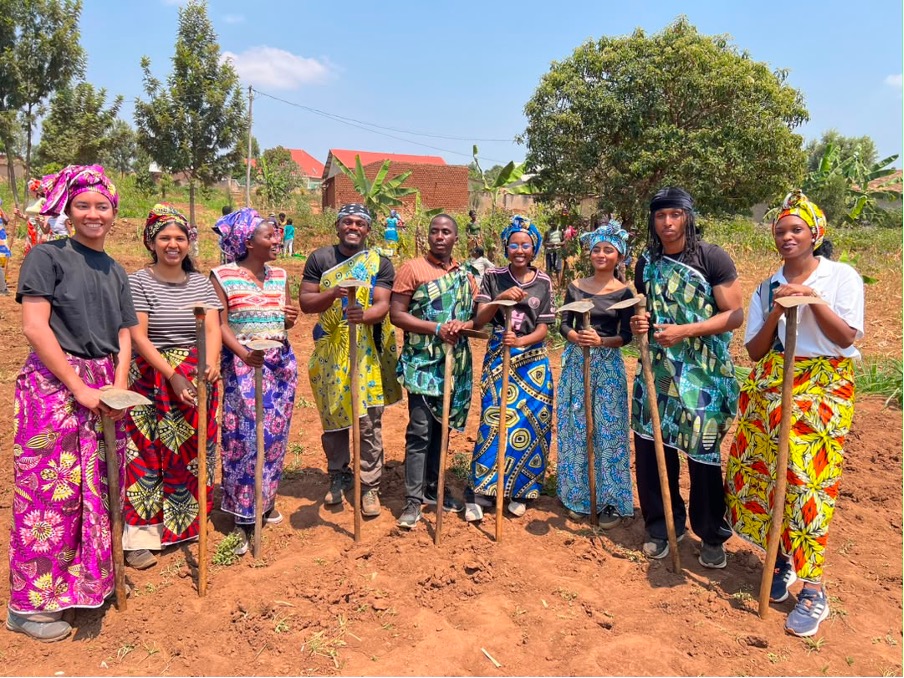
The women artisans greeted us straight away with real warmth. They came out singing and dancing, pulled us into their circle and welcomed us into their culture with open arms. Before we knew it, we had joined in as well.
The energy they brought throughout the day was infectious and immediately made us feel comfortable in a completely new environment.
During the day, we helped collect water from the well, prepared the lunch we would eat later, worked on crops, carried banana leaves and made our own Rwandan bracelets.
Everything the artisans did came with a smile.
What stayed with me the most was how much the day was shared. Nothing was done alone. Fetching water, cooking and farming were all done together, with singing and conversation throughout.
Back home, so much of daily life happens individually and in a rush. Here were women doing physically demanding work while still making time for each other and for complete strangers like us.
It made me rethink what community really means. It isn’t just living near each other but carrying the load together.
It also made me aware of my own habits, like how quickly I rush through things and how rarely I stop to properly enjoy the people around me. I think that level of generosity and patience is something I want to hold onto.
Connecting law, fair trade and international business
In my degree, I’ve studied economic and social rights and how they have developed through legal frameworks and case law.
At Azizi Life, I saw what those ideas look like when they work in practice. Things like fair pay and recognition of skills weren’t something abstract but rather the difference between a hobby and a livelihood.
We got to watch some pieces being made and we even tried making our own pottery. Our shabby attempt only showed how skilled the artisans really are.
The CEO also took time to explain how their products reach international markets through their store in the US.
It made me think about the legal side of that journey. How do you set a price that is fair to the artisan but still competitive abroad? How do fair trade standards, import rules and consumer labelling requirements affect a small social enterprise compared with a large company?
It shows that handwoven products pass through a whole web of trade and regulatory frameworks, and each one affects how much value makes its way back to the women who made them.
It also raised questions I’d like to explore further in my studies. How are traditional designs and craftsmanship protected when they enter international markets?
It kind of sounds like I left with more questions than answers, but I think that’s a good thing.
Why listening matters in law and international volunteering
As law students, we’re trained to find the issue, apply the rule and reach a judgement. A lot of us did this instinctively in Rwanda, where we spotted problems and jumped to solutions.
However, we quickly learned this wasn’t always the best approach.
When I pitched my café solution to my Rwandan team leader, she explained that many local Rwandans see coffee as something to sell rather than something to sit down and enjoy. So even if people knew the café existed, there was still a social and cultural barrier that raised the question of whether they would come at all.
That really showed me how important it is to listen and understand the context you are working in before rushing to an answer.
It’s also very relevant to how a good lawyer works. You need to understand your client and what they actually want instead of doing what you assume they want.
What I learned from my experience in Rwanda
The whole experience helped me come back with a better sense of how law, business and community connect.
Good frameworks matter, but they only work when they are shaped by the people they are meant to serve.
On a more personal level, the lesson I want to put into practice is simply to talk to more people.
I realised that someone who seems closed off at first is often just waiting for a conversation. Many of the people I might not normally have gone up to turned out to be people I connected with most once I sat down and spoke to them.
I realised that connection doesn’t only come from what you have in common. Sometimes your differences can bring you just as close.
Written by Ruhale Abraham, Undergraduate Law Student.
Related
Contact Us
+44 (0) 161 306 6000


0 Comments