

Newsletter Edition #1
It’s our third year, and there are more things to report on than we could have imagined. We’ll only be able to point to some of these in each edition.
Hub research has two key elements: the Physical Hub means the Lennon Lab group in Manchester and collaborators elsewhere; and the Virtual Hub includes research into human disease via genetics, epidemiology, and clinical studies. The 1200+ patients in the RaDaR renal rare disease registry are key to this research.
Physical Hub
Systematic assessment of variants
Complementary methods to to evaluate the functionality of genetic variants in collagen IV genes. In vitro assays and in vivo testing systems. Some assays also permit early testing of some therapeutic approaches.
Specialist analysis of treatment effects
In animals and patients – a platform for complex assessment of protein expression and distribution in biopsies and samples from animal research or clinical trials.
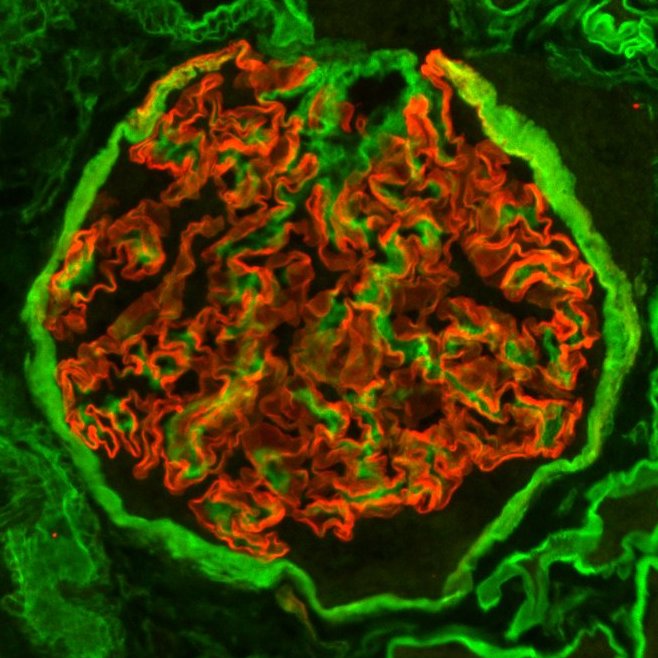
Immunofluorescence image of a healthy human glomerulus using pan-collagen IV antibody (green; ab6586) and collagen IV alpha 3 antibody (red; Chondrex 7076 (H31), imaged on a Zeiss Axio Imager.D2 microscope (Bioimaging Core Facility, FBMH, University of Manchester).
Molecular pathways influenced by therapy
Elucidating molecular pathways influenced by treatment. We know that ACE inhibitors work – do we understand how and why (by examining protein expression and proteomics). A parallel study is looking at the second approved preventive therapy for patients, SGLT2 inhibitors.
Analysis of matrix turnover
Validating data from proteomic studies in Alport mice. Links to our biomarker studies (to be mentioned next time).
AI-based system to analyse basement membranes
Focused on the changes in morphology of the glomerular basement membrane (GBM) of the Alport kidney.
Virtual Hub
RaDaR cohort development
Maximising enrolment of patients, and ensuring that they have a minimum dataset, is critical to both understanding more about risk to individuals, and identifying those who may be eligible for new treatments. We are speaking individually to staff in RaDaR recruitment centres.
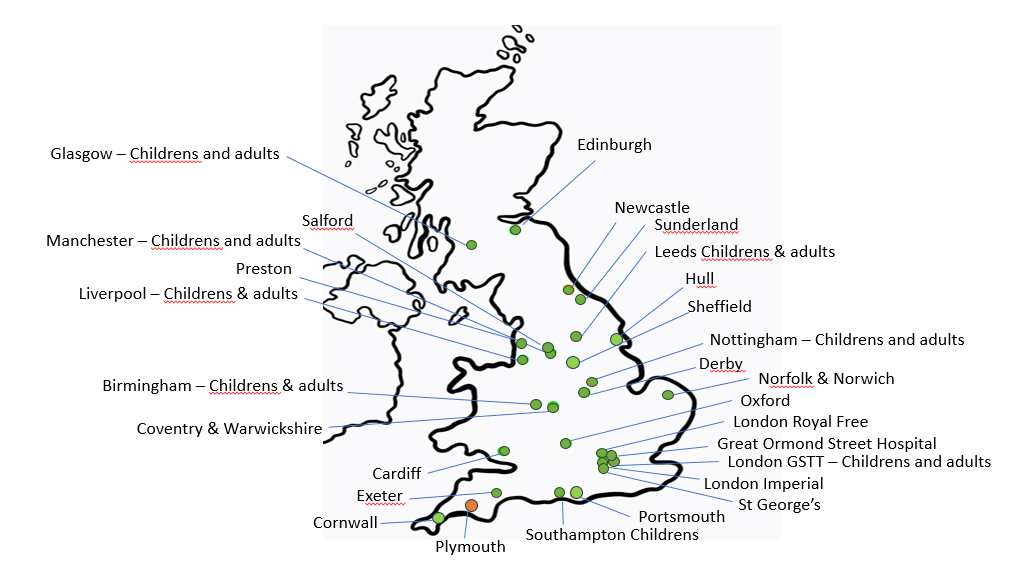
Map of the UK visualising Hub engagement with RaDaR sites
Audiograms
We have begun to test with audiologists how to add data to RaDaR. The hearing problems of Alport patients have been largely neglected by previous research.
Genetic tests
From the two major sequencing centres in the UK have been added to RaDaR records, enabling identification of patients with mutations that may be amenable to specific treatments, possibly including gene therapy.
Genomics of Alport Syndrome
We are planning for whole genome sequencing of the RaDaR cohort, including a series of regional events.
Key Publications
We’ve picked just 5 to highlight here, for a comprehensive list please visit the Hub Website.
Preston R et al 2025. The glomerular circadian clock temporally regulates basement membrane dynamics and the podocyte glucocorticoid response. Kidney Int 107:99-115.
Gale DP et al 2024. HERA Clinical Trial Group. A Randomized Controlled Clinical Trial Testing Effects of Lademirsen on Kidney Function Decline in Adults with Alport Syndrome. Clin J Am Soc Nephrol 19:995-1004
Tian P et al 2024. Collagen IV assembly is influenced by fluid flow in kidney cell-derived matrices. Cells Dev 179:203923.
Ng NSL et al 2024. Detection of Alport gene variants in children and young people with persistent haematuria. Pediatr Nephrol 40:719-729.
Wong K et al 2024. Effects of rare kidney diseases on kidney failure: a longitudinal analysis of the UK National Registry of Rare Kidney Diseases (RaDaR) cohort. Lancet 403:1279-1289 (Alport in supplementary data)
‘Deep Dive’
International Workshop on Alport Syndrome – Beijing 2025
This amazing meeting in September brought together leading researchers, clinicians, patients, and pharma from around the world for 3 days. 150 attended a patients-only day and some stayed throughout. The collaborative ethos of these workshops is remarkable amongst rare kidney diseases. The UK team contributed a dozen talks and was involved in almost all parts.
? Meeting insights
- Genetics – understanding and explaining the variable risks to heterozygotes; informative terminology; protective/accelerating genes.
- Fix the genes? Potential for ‘whole gene’ therapy has made rapid progress in mice – but timing of therapy looked critical. The first mutation-specific treatment in humans is leading to a further clinical trial thanks to detailed analysis at the Alport hub. Several other approaches are jostling for a place. The potential for protein therapies was impressively advanced by Sergey Budko.
- ‘Slowing’ therapies: which drugs – which drug combinations – who for and when to start. More changes in recommendations to be expected from this. But multiple potential new targets were also discussed; some are close to or in clinical trials already.
- Ears and eyes – a ‘groove’ audiogram pattern is common, not just high tone loss. Lateral retinal thinning can be a useful sign in young adults with Alport. Animal models now being studied.
- Needed worldwide – further growth of registries. Education for nephrologists in managing Alport; and for primary care on identifying and referring kidney disease in younger people.
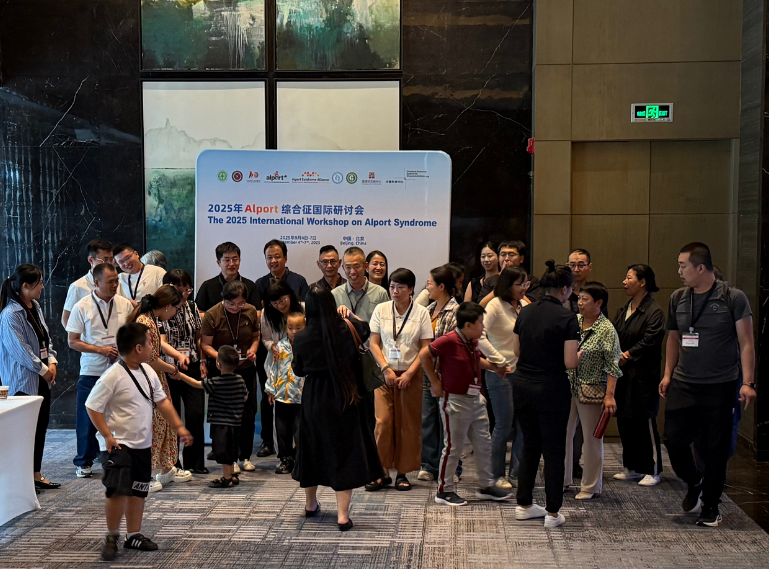
Chinese patients
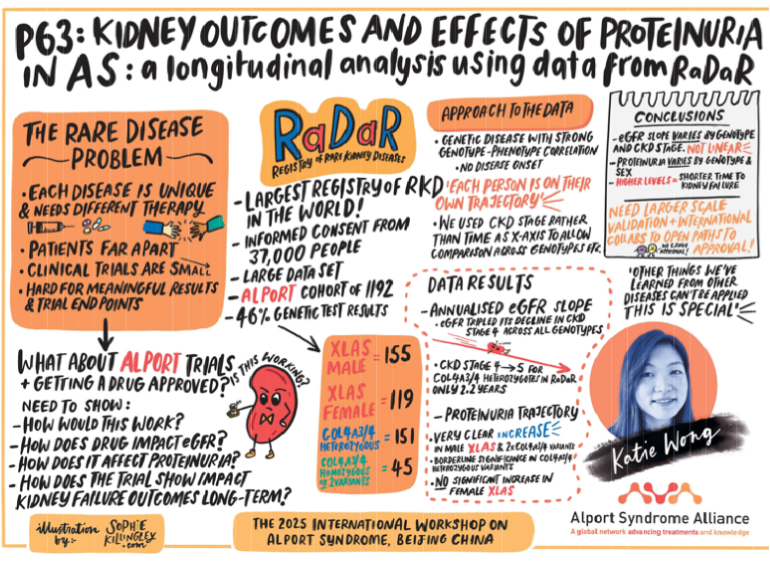
Artist’s Notes
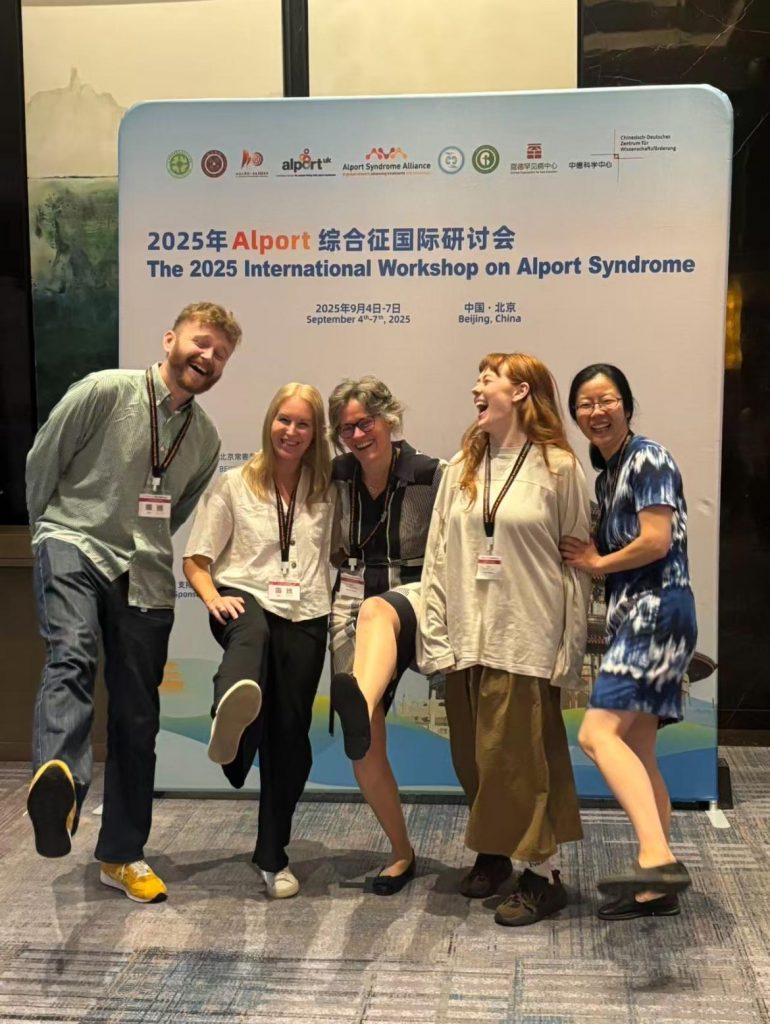
Manchester team
Related
Contact Us
+44 (0) 161 306 6000

0 Comments