

Newsletter Edition #2
2026 Alport Research Hub Symposium
Planning is in progress for an all-day meeting on Friday 3 July at the Institute for Child Health in central London. It will be followed by an Alport UK Information Day (Saturday 4 July) for patients and families, also in London (Westminster Boating Base, 136 Grosvenor Rd, Pimlico, London SW1V 3JY).
The symposium will include a keynote talk from Brian Stramer (Kings College London) entitled: “How do basement membranes form?” Brian is a world leading Drosophila researcher, and he will demonstrate how studying model systems like the fly can help us understand more about human basement membranes. Any researchers or clinicians interested in Alport are welcome to attend, and the meeting will also include representation from pharmaceutical companies, who will present outcomes from recent or ongoing clinical trials for Alport – there are several!
New: Abstracts
For the first time we will be running a poster session for researchers and abstracts will be selected for oral presentation on the day. The abstracts submission deadline will be Monday 27th April. Further information will be provided after expressing interest via the Registration page.
- Register your free place for the symposium (Kidney Research UK)
Hub research
The Alport Hub research has two key elements: the Physical Hub which covers laboratory-based research in Manchester, Nottingham and London; and the Virtual Hub which includes research into human disease with genetics, epidemiology, and clinical studies across the UK.
Physical Hub updates
Here are some of the current projects in the Manchester and London labs:
Improving cell-based screening assays for collagen IV variants
To test the function of variants in the Alport genes that have been identified in UK Biobank. The assay can measure effects on collagen IV trimer assembly, secretion, and function, and be used to test possible therapies such as chemical chaperones or gene therapies.
Stem cell-based models of Alport
CRISPR-Cas9 techniques can generate podocytes and kidney organoids from human stem cells. These closely resemble native kidney cells and enable studies of basement membrane formation, variant pathogenicity, and therapeutic rescue.
AI-based system to analyse basement membranes
To support these models and interpret human biopsies we are beginning to test automated measurements of basement membrane structure against our manually measured datasets. We aim to generate accurate basement membrane width measurements for future projects and produce high-quality training material for further development of AI-based approaches.
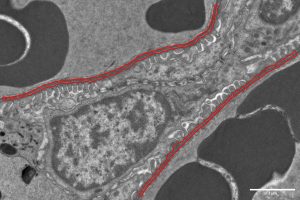
“TEM image of a kidney glomerulus, highlighted in red is the GBM to be quantified.” [Manual – AI comparison to follow!]
The Immune System and Alport Syndrome
A number of features suggest that a dysregulated immune response may contribute to disease progression. In a collaboration between the Lennon and Gale labs we are inducing localised inflammation in glomeruli to study whether a mouse model of Alport syndrome responds differently to inflammation compared to controls.
Virtual Hub updates
RaDaR cohort development
The 1301 patients in the RaDaR rare kidney disease registry are key to clinical research. Having already engaged with top RaDaR recruiting sites we are moving on to those that are recruiting well overall, but who have fewer Alport recruits – suggesting there may be capacity for recruitment. This work is essential to prepare for upcoming clinical trials.
Audiology
Hearing loss is an under researched aspect of Alport Syndrome. Our colleagues with the hearing Health Informatics Collaborative (HIC) in Manchester are working on ways to transfer information from the audiology databases into RaDaR. More below on additional research into hearing aspects of Alport syndrome.
External projects
2025 Recipient; Devin Peipert, University of Birmingham
The third external project secured through Hub funding. We will hear more at the Hub Symposium in July about this exciting project: Patient Reported Outcome Measures (PROMs) for Alport patients with a focus on hearing.
2024 Recipient: The Ear Institute, UCL (Dan Jagger)
What’s happening in the cochlea? We don’t understand the cellular and molecular basis of hearing loss in Alport nearly as well as we do kidney disease. The main aims are to:
- Study where Alport molecules are in cochlear and vestibular tissues of normal mice through life and compare to human Alport samples.
- Compare Col4a5 knockout (Alport) mice to show how basement membrane structure and function change.
- As proof-of-concept, test whether gene therapy can reach inner ear tissues.
Towards the first aim, we are using high quality commercial antibodies and novel antibodies made in Manchester that bind the intact collagen IV alpha-345 trimer. In parallel, analysis of transcriptomics is investigating which cells produce COL4A3,4,5 chains – important if gene therapy is to target the right spot.
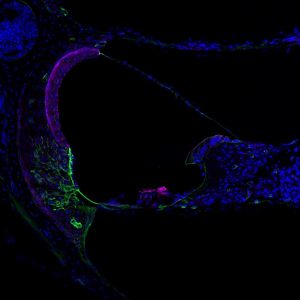
“Image of the cochlea with collagen COL4A3/4/5 highlighted green”
Pharma collaborations
Gene therapy in Alport syndrome (Deerfield Management/FourPoints Innovation)
This project is progressing well and was recently extended. We published the first paper from this collaboration in March 2025. It is a methods paper reporting a quantitative analysis platform of rAAV9 transduction in podocytes in vitro, ex vivo, and in vivo. With these approaches we demonstrated increased transduction in Alport podocytes, giving confidence that rAAV9 could be used as to delivery gene therapy.
Preclinical Evaluation of Setanaxib in Alport Syndrome (Calliditas Therapeutics)
We have completed experimental work for the preclinical evaluation of setanaxib in Alport syndrome. This study was presented as a poster at the ASN conference in 2023. Calliditas progressed to funding a Phase 2a clinical trial and the Hub team have supported the presentation of this Phase 2a study.
A Phase 2A trial of the read-through drug ELX02 (Eloxx Pharmaceuticals)
When caused by a nonsense variant, Alport syndrome typically leads to kidney failure by late adolescence. ELX02 promotes readthrough of premature, but not native, termination codons, enabling full-length protein production in podocytes or tubular cells. Three individuals (ages 12-19) with COL4A4 nonsense variants were treated with ELX-02 for 8 weeks. We assessed the molecular composition of laser-micro dissected glomeruli pre- and post-treatment by mass spectrometry-based proteomics, and we validated the presence of COL4 proteins by immunofluorescence. The data supports further trials of ELX-02 in Alport syndrome, and the project highlights the synergy between the virtual Hub for patient identification and the physical Hub for analysis to determine whether there were changes in the level of the Alport collagen.
Additional commercial interest
We have engaged in discussions with 18 additional companies regarding potential collaborative projects. We finalised a third collaboration with Visterra, which commenced in 2025, and we are now developing new study plans with two additional companies. We remain proactive in engaging with both academic and commercial partners to provide guidance on their Alport research programmes and to explore options for accommodating additional projects whenever feasible.
Publications & Abstracts
Hassan Saei, Bruno Estebe, Nicolas Goudin, Mahsa Esmailpour, Julie Haure, Olivier Gribouval, Christelle Arrondel, Vincent Moriniere, Pinyuan Tian, Rachel Lennon, Corinne Antignac, Geraldine Mollet, Guillaume Dorval. Splice modulation of COL4A5 reinstates collagen IV assembly in an organoid model of Alport syndrome. JCI Insight 2025
Charles Gyasi, Rachel Lennon, Rebecca Preston Circadian rhythms and glucocorticoid dynamics in the kidney matrix. Nephron in press.
Thomas M Oates, Moumita Barua, Susie Gear, A Neil Turner, Rachel Lennon, Hirofumi Kai, Daniel P Gale, Marina Aksenova, Judith Savige, Oliver Gross, Laura Massella, Jeffrey H Miner, Constantinos Deltas. Update on Alport syndrome: the report of the 2024 International Workshop on Alport syndrome. Kidney International Reports in press
|
Aimi Owaki, Shota Kaseda, Shunsuke Tanigawa, Koichiro Miike, Yuya Sannomiya, Haruki Tsuhako, Ryoichi Sato, Keito Mizumoto, Jun Horizono, Ryo Kumabe, Midori Tokuyasu, Yukio Fujiwara, Toru Takeo, Kimi Araki, Bernard Davenport, Rachel Lennon, Tsuyoshi Shuto, Ryuichi Nishinakamura, Mary Ann Suico, Hirofumi Kai. Protective role of early Tnfsf15 upregulation in limiting glomerular injury and proteinuria in experimental Alport Syndrome. Journal of Pharmacological Sciences in press. Luisa Ulloa Severino, Xiaolin He, Julian Kennedy, Kendrix Kek, Adriana Krizova, Franziska Lausecker, Christopher Yip, Rachel Lennon, Mira Krendel, Darren A. Yuen. Reduced podocyte stiffness is a feature of proteinuric kidney disease. Kidney International in press. |
Significant abstracts will be presented at the Harrogate meeting of UKKA in March, and the ERA meeting in Glasgow in June. For a comprehensive list of publications please visit the Hub Website.[ https://sites.manchester.ac.uk/alport-hub]
Deep Dive – the ASSENT project
The Hub team has been a substantial contributor, with colleagues around the world, to the Alport Syndrome Surrogate Endpoints Network (ASSENT) project – a new international collaboration to improve how clinical trial results are interpreted. It brings regulators into conversation with patient groups, registries, researchers, triallists, and others.
Data from RaDaR, the UK rare renal disease registry, were presented at the US Food and Drug Administration (FDA) in Washington DC in December. A shared approach to analysing registry data was agreed, and a global consortium of Alport registries was launched.
This work aims to accelerate the development and approval of new treatments for people with Alport syndrome.
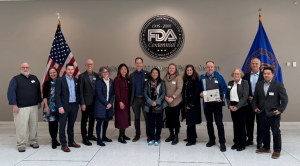
Image of Hub members and collaborators at the FDA. From Left to Right: Les Kirchner (Geisinger, US); Michelle Rheault (Minneapolis, US); David Pitcher (RaDaR, UK); Jeff Miner (St Louis, US); Rachel Lennon (Manchester, UK); Katie Wong (RaDaR, UK); Daniel Gale (RaDaR, UK); Barbara Gillespie (ISGD, US); Abby Smith (Northwestern, US); Lisa Bonebrake, Andre Weinstock, Sharan Lagos (ASF, US); Jim Simon (Cleveland, US); Ulysses Diva (California, US).
Related
Contact Us
+44 (0) 161 306 6000

0 Comments