

Newsletter Edition #3
May 2026
2026 Alport Research Hub Symposium
We would like to take the opportunity to remind you that our 2026 Hub Symposium will take place on Friday 3rd July at the Institute for Child Health in central London. We hope you can join us! Though we encourage in-person attendance there will be an option to join remotely on request for those who register.
Alport Patient Information Day
The Symposium will be followed by an Alport UK-led Information Day on Saturday 4th July for patients and families, also in London, at Westminster Boating Base.
This is a FREE for patients to join and open to everyone. It is an informal event created by those living with Alport Syndrome and local clinicians.
- Please register your interest or email Alport UK directly: info@alportuk.org
Hub Research
The Alport Hub research has two key elements: the Physical Hub which covers laboratory-based research in Manchester, Nottingham and London; and the Virtual Hub which includes research into human disease with genetics, epidemiology, and clinical studies across the UK.
Physical Hub updates
Spatio-temporal mapping of the Col4a5-/Y mouse model of Alport syndrome to identify early biomarkers of focal kidney injury
As a new member of the Physical Alport Research Hub, Richard Naylor has been characterising in detail how kidney disease develops in the Col4a5-/Y mouse model. This work has focused on defining the earliest affected regions and the timing of disease onset.
Richard has identified Cd44, αSMA, PCNA, and Iba1 as sensitive early biomarkers of both glomerular and tubular injury in this model of Alport syndrome. Together, these markers reflect key aspects of disease progression, including tissue injury, cellular proliferation, and immune cell infiltration.
Of particular interest is Cd44, which shows strong potential not only as an early indicator of disease but also as a therapeutic target. Its expression raises the possibility of delivering drug therapies specifically to regions of early kidney damage, with the aim of slowing disease progression.
Virtual Hub updates
RaDaR cohort development
We are continuing to engage with RaDaR sites to ensure the Alport cohort is ready for upcoming clinical trials as well as planned Hub workstreams to include Whole Genome Sequencing (WGS) and creation of a NuRTURE – Alport Biobank. Further information will be shared in upcoming newsletters.
Audiology
Anita Visram with the hearing Health Informatics Collaborative (HIC) in Manchester has recently drafted a funding proposal to enable the team push forward with this work. The team plan to extract Auditbase data from NHS records in Manchester, describe the data in terms of presence / completeness / quality for various fields of interest, and then test the transfer of an initial dataset into RaDaR. We should then be able to carry out initial analyses of hearing function and develop future research plans including:
- Appropriate further analyses based on deeper knowledge of the dataset
- Develop future research plans to mimic data transfer from different NHS centres
- Develop future research questions involving direct contact with the patient population
- Apply for follow-on funding to address identified research questions
The Hub team are working with Anita to obtain funding to advance this project.
External projects funded via Hub Grant rounds
Patient Reported Outcome Measures (PROMs) for Alport patients with a focus on hearing.
Alport syndrome affects not only the kidneys but also can have severe impact on hearing, with many people developing hearing loss early in life. However, this hearing loss is not well understood or well measured. As new treatments are being developed—not only to protect kidney health but also to prevent or improve hearing—it is important to better capture how hearing loss impacts daily life.
This project will create patient-centric measures for patients and caregivers to report how hearing loss affects quality of life. By interviewing people with Alport syndrome and their families, refining these tools, and testing them in a larger study, we aim to ensure future treatments focus on what truly matters to patients and can accurately measure improvements in hearing-related outcomes. The primary objective will be to implement these measures in clinical trial endpoints.
Devin Piepert and his team are linking in with Anita and the HIC to see how best these two projects can collaborate.
Publications & Abstracts
- Rebecca Preston, Anna Hoyle, Emily Williams, Alana Stevenson Harris, Ko Tsutsui, Chloe Williams, Catherine Park, David Spiller, Leo Zeef, Solveig Skovlund Groen, Federica Genovese, Joan Chang, Qing-Jun Meng, Joe Swift, Alexander Eckersley, Rachel Lennon. Accelerated basement membrane remodelling and serum matrix fragments as biomarkers of fibrosis in Alport syndrome. Cell Reports, 2026
- Alicia B Byrne, Anna S Li, Edmund YM Chung, Enyonam Edoh, Hannah Dziadzio, Pamela Ajuyah, Elisabet Ars, Yasar Caliskan, Ahmet Burak Dirim, Mark D Elliott, Asheeta Gupta, Kushani Jayasinghe, Andrew J Mallett, Julie C Ratliff, Matthew G Sampson, Judy Savige, Johannes S Schlondorff, Zornitza Stark Ryan F Webb, Parker C Wilson, Janewit Wongboonsin, The ClinGen Glomerulopathy Gene Curation Expert Panel, Martin R Pollak, Hugh J McCarthy, Catherine Quinlan, Rachel Lennon. Gene–disease relationships for glomerular phenotypes: expert recommendations from ClinGen. Nature Review Nephrology, 2026.
- Rachel Lennon, Jeffrey H Miner, Judy Savige, B André Weinstock, Susie Gear. Alport: Renaming an Extended Clinical Spectrum. Journal of the American Society of Nephrology: JASN, 2026
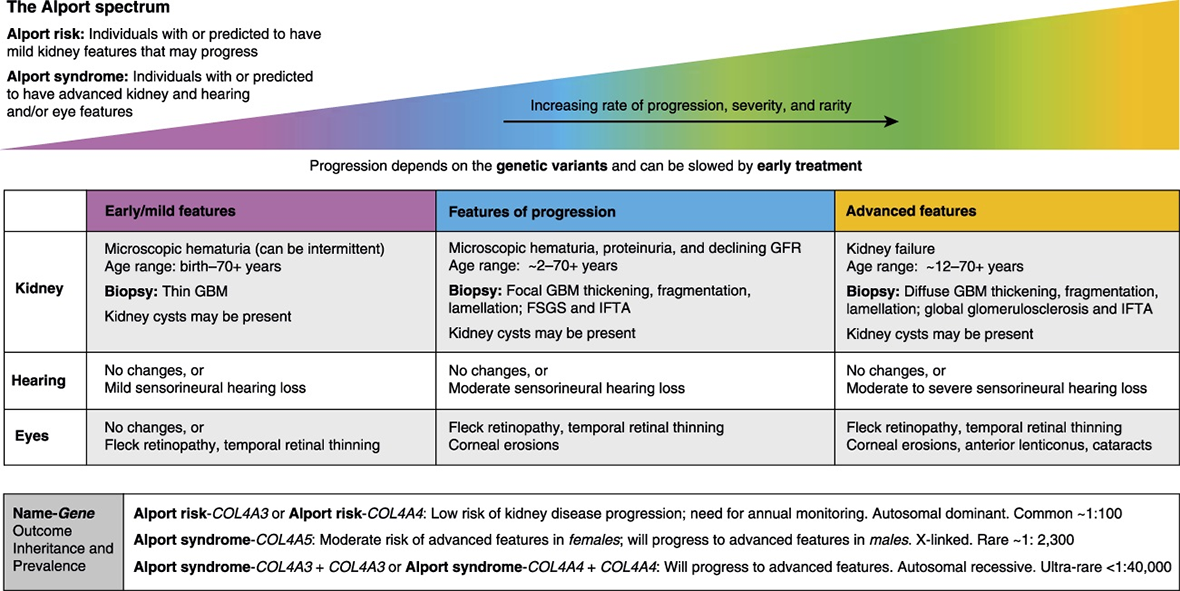
Proposed naming convention for conditions associated with Alport gene variants. The Alport spectrum is the overarching classification with two subcategories: Alport risk and Alport syndrome. The dyadic naming convention pairs these subcategories with the name of the affected Alport gene, and the risk of developing advanced clinical features depends on the genetic variant. In all individuals with Alport risk or Alport syndrome, the progression of the kidney features can be slowed by early kidney protective treatment (e.g., ACE inhibitors), and therefore, all individuals should have lifelong kidney surveillance.
Significant abstracts will be presented at the ERA meeting in Glasgow in June. For a comprehensive list of publications, please visit our publications page.
Deep Dive – New research identifies circulating biomarkers of kidney fibrosis in Alport syndrome
What have we found?
Rebecca Preston and the team in Manchester have used a combination of cutting-edge techniques to map how the kidney’s structural scaffolding, known as the extracellular matrix, breaks down over time in Alport syndrome.
Using a mouse model, they found that key basement membrane proteins including collagens, laminins and nidogens are being broken down far more rapidly than normal, suggesting that the balance between protein production and degradation is lost in Alport syndrome. The basement membrane forms a critical part of the kidney’s filtration barrier, and its disruption is central to disease progression. The team identified the specific enzymes responsible for this breakdown and were able to predict which kidney proteins are being cleaved. These fragmented matrix proteins were then measured in blood samples from children and young people with Alport gene variants. Remarkably, circulating matrix fragments reflecting breakdown of the kidney filtration barrier were detectable even in children who had not yet developed significant protein in their urine, indicating that kidney damage can be detected at an early stage.
Why does this matter and what is the impact?
These circulating matrix fragments could serve as early warning signals of kidney damage, detectable through a simple blood test before conventional signs of disease appear. This could enable earlier intervention and better monitoring of kidney fibrosis and may also help assess whether new treatments, including gene therapies, are working.
Rebecca’s manuscript has recently been published in Cell Reports and is listed in the Publications & Abstracts section above.
Full text publication: Accelerated basement membrane remodeling and serum matrix fragments as biomarkers of fibrosis in Alport syndrome
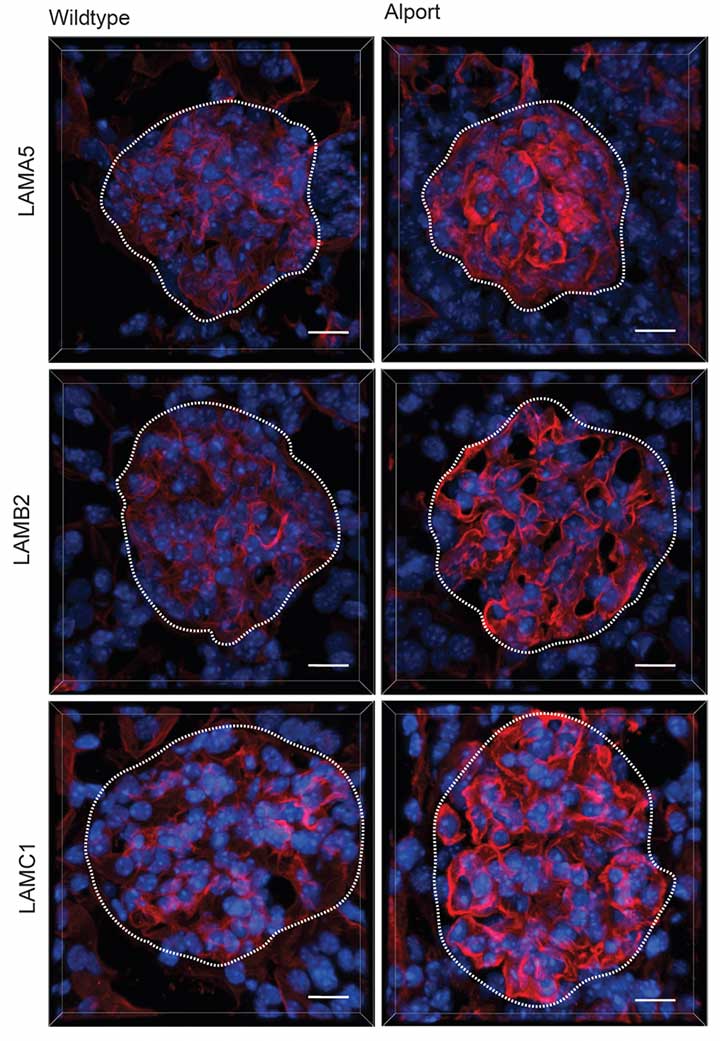
Microscopy images of the kidney filter in a healthy mouse (left) and a mouse with Alport syndrome (right). The red signal shows laminin, a key structural protein that normally forms an organised network in the kidney filter. In Alport syndrome, this network becomes disorganised and disrupted, contributing to kidney damage.
Related
Contact Us
+44 (0) 161 306 6000

0 Comments