
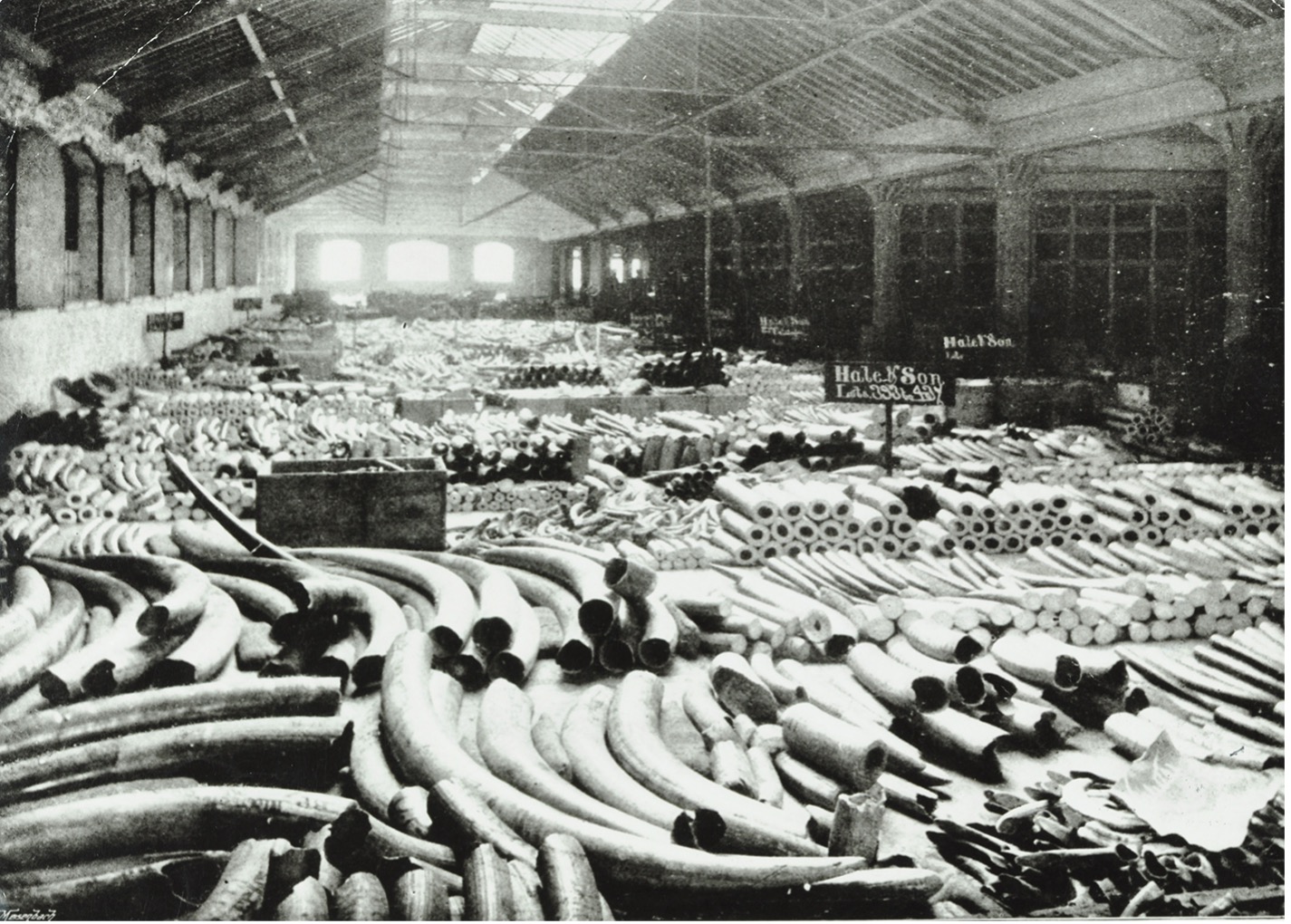
New journal article on port labour, global commodities, and material skill development: a study of the ivory warehouse in the Port of London and its representation c.1860-1968
Dr Ali Bennett is Lecturer in Art History at the University of Oxford’s Department of Lifelong Learning, and a former member of the Bodies, Emotions and Material Culture Collective. In this post, she offers an overview of her new journal article, recently published in Revista de Historia Industrial–Industrial History Review (RHI-IHR), which focuses on port labour, global commodities, and material skill development in the Port of London ivory warehouse.
In 2024, I was invited by my BEMCC colleague, Dr Alka Raman, to participate in a workshop titled The Connected World: New Perspectives in Global Economic History. At the time, I had recently uncovered a substantial body of sources relating to the Port of London’s ivory warehouse while conducting research for my three-year Hallsworth Fellowship on the East African ivory trade at the University of Manchester. These materials offered the basis for a compelling case study, which developed into the paper underpinning this article.
By the turn of the twentieth century, ivory was a widely used material, central not only to luxury production but also to a range of middle-class domestic goods, including umbrella handles, chess sets, rulers, doorknobs, combs, and even teething rings. The ivory warehouse at St Katharine Docks in London (built in 1860 and closed in 1968) played a pivotal role in facilitating this trade.
My research offers the first substantial examination of ivory warehouses, either in London or elsewhere. Although ivory godowns operated in ports across the globe—from Mombasa and Surat to Hamburg, Antwerp, Manila, and New York—the London warehouse offers a particularly significant case. During the nineteenth and twentieth centuries, London was among the world’s largest ports, and Britain was the leading importer and re-exporter of African ivory. The warehouse functioned as a busy intermediary space, connecting exporters in Africa and Asia with manufacturers worldwide. As such, it provides valuable insight into ivory’s global circulation and its diverse commercial uses.
Presenting a revised version of this research to the Bodies, Emotions and Material Culture Collective prompted me to reconsider the site through the lenses of material culture and embodiment. The resulting article argues that an economic history of the ivory trade must also account for the sensory and material experiences of labour. It examines how global commodity trade fostered the development of localised skills among Britain’s labouring classes, focusing on how sustained work with ivory generated new forms of geographical and commercial knowledge among Port of London warehouse workers and brokers responsible for preparing ivory for market.

Scraping Ivory at London dock, 1935, Source: PLA/PLA/PM/6/3/54
Contemporary newspaper accounts and photographs of the warehouse reveal that prolonged sensory engagement enabled these workers to develop an intimate understanding of ivory’s material properties and global origins—even though many had never left Britain or encountered an elephant. This form of ‘useful knowledge’ shaped how efficiently one of the nineteenth century’s most highly prized raw materials was sorted, stored, and marketed. This in turn influenced ivory’s commercial value, its transformation into specific commodities, and the quality of the finished products. Such dynamics remain largely obscured in purely quantitative approaches to economic history.
The workers’ embodied labour and material expertise also played a central role in their public representation as experts within the global commodity chain. The Port of London Authority’s publicity department promoted this image through commissioned photographs and newspaper features. Of course, specialist material skill and knowledge were essential at every stage of the ivory commodity chain—from extraction of the tusk to its manufacture and consumption. The London ivory warehouse constituted but one crucial node within a wider network of ecological, social, and economic relations underpinning the global ivory trade. I argue that the portrayal of London’s port workers as skilled experts contributed to a broader, constructed global hierarchy of labour, manufacture, and consumption.

Marking Ivory, Source: 1947, PLA/PLA/PM/6/3/54
Existing scholarship often addresses the relationship between global commodities, embodied labour, and visual marketing at the level of artisanal or industrial production. This article demonstrates that these dynamics were equally central to port warehousing and trade. By examining ivory as a case study, the article offers a broader framework for understanding how global commodities were mobilised, transformed, and marketed to manufacturers and consumers worldwide through port warehouses.
The final article is available here:
https://revistes.ub.edu/index.php/HistoriaIndustrial/article/view/48131
Related
Related posts:
Contact Us
+44 (0) 161 306 6000


0 Comments