
New article ‘Widows, orphans and churches: protection and virtue signalling in the Carolingian world’
In this post, Dr Ingrid Rembold (Manchester) discusses her new article in the English Historical Review.
My recent EHR article, ‘Widows, orphans and churches: protection and virtue signalling in the Carolingian world’, is the most aggravating thing I’ve ever written. It also happens to be the publication in which I take the most pride, which is why I’m delighted to have been asked to contribute a blog post on the subject. I’d always been of the belief that good argumentation, when it comes, flows naturally. My most recent article (‘Was Einhard a widower?’), a short think-piece in lieu of a definitive contribution, was written over the course of a week and finished on a short train journey; with a few minor revisions, and after a few weeks of footnoting, it was dispatched with relative speed. By contrast, the research that led to ‘Widows, orphans and churches’ stretched out over a decade, with countless drafts and false starts. I’d love to write something of similar quality without such a tortuous process; accordingly, reflecting on said process, and how my article came into being, could do me some good.
The first draft of this article was the very first thing I wrote in my first postdoc; it took the form of a 50-minute paper, delivered in extremely shaky German. Per usual, my project had been conceived around a question that I could not work out. My understanding of Carolingian governance was formed by Matthew Innes’ State and Society (2000), a compelling work which examined how, in the absence of ‘governmental administration’ as such, Carolingian rule was articulated within extant social structures, here notably monasteries and their local networks. I was, and remain, convinced, but I was nevertheless stuck on a particular part of the model: namely, the idea royal grants of protection transformed monasteries into so-called ‘royal monasteries’ (Königsklöster, Reichsabteien), and in so doing changed their legal status. Such a model was by no means confined to Innes’ excellent work, but rather featured heavily in recent scholarship. Barbara Rosenwein’s significant study of charters of immunity and immunity-protection, Negotiating Space (1999), had made such an argument; its religious and governmental implications were most clearly expressed in Mayke de Jong’s 1995 article and Hans Hummer’s 2005 book. None of these works spoke explicitly in terms of a Reichskirchensystem (imperial-church system), a framework originally developed in relation to the Ottonian empire, but the implications were clear: monasteries were annexed as an arm of the ‘state’ through the legal mechanism of protection.
This did not make sense to me. I read and reread extant grants of protection – helpfully labelled as such (Schutz, Immunität und Schutz) in the standard editions of royal charters produced by the Monumenta Germaniae Historica. I likewise read and reread Susan Wood’s Proprietary Church (2006), a work Jinty Nelson described as Wood’s Middlemarch, trying to understand how a large monastic institution could be ‘owned’ in any meaningful sense of the word (primarily, in Wood’s argument, through the right to appoint an abbot or abbess). Walter Goffart’s surprisingly underappreciated Le Mans Forgeries (1966) offered a route of understanding ownership of monasteries, not as a legal fact, but rather as flexible packages of competing claims, deployed with various success to various ends, many of which fall far short of modern ideas of ownership. Both Goffart and Wood had rightly shied away from easy answers; the sheer complexity of both works precluded broad acceptance. But neither had tackled the prevailing model wherein protection was equated to ownership or control, and, for my part, I had become increasingly convinced that grants of protection, by and large, did not exist.
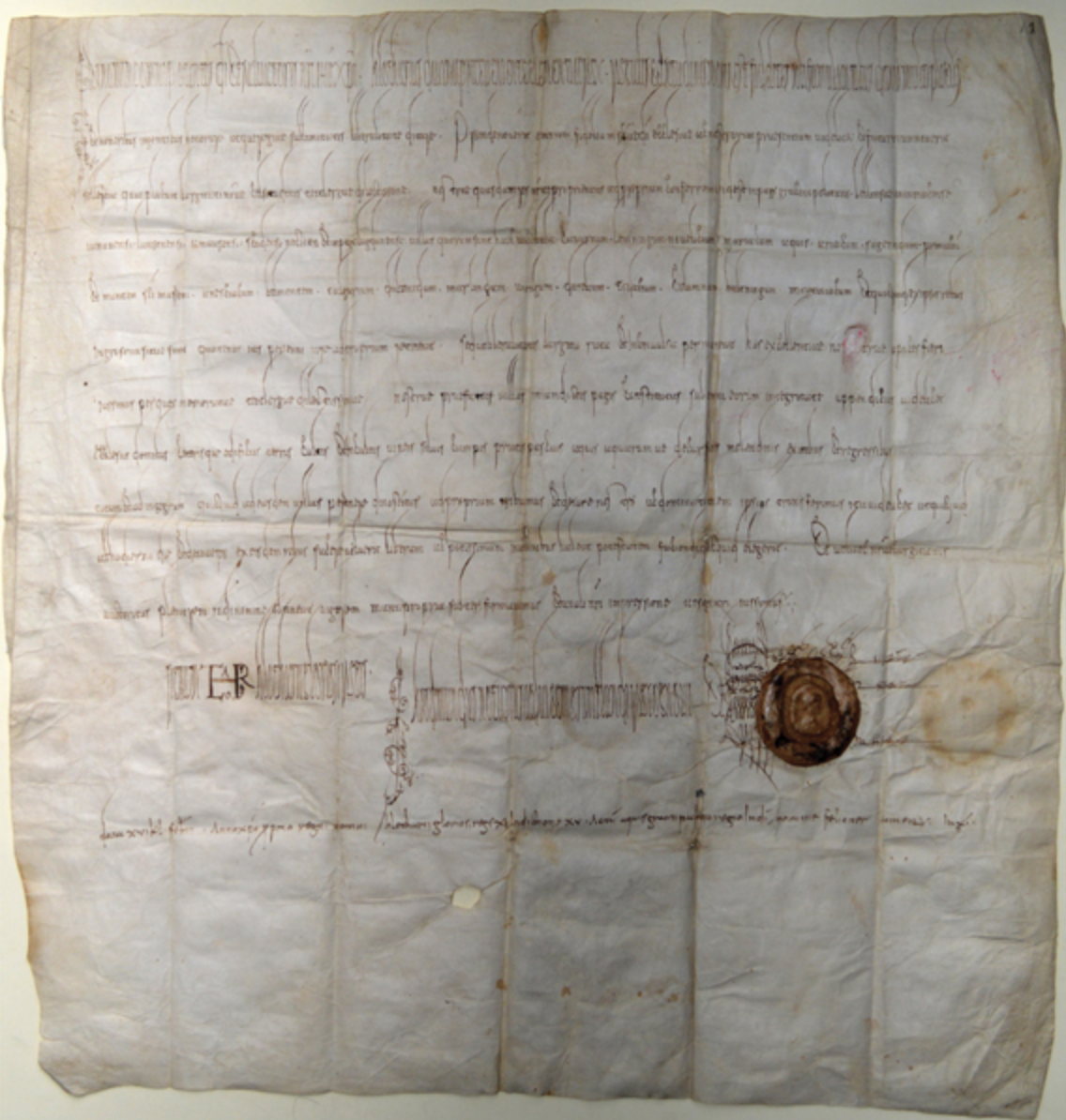
In the charters, protection – Schutz – corresponded to a broad array of terminology. Unlike other grants, protective language was employed without set phrases or conditions; it appeared to be invoked as a topos or rhetorical flourish as opposed to a binding legal mechanism. And so my first attempt at the subject simply knocked things over; it followed a negative argument, arguing against the category of ‘grants of protection’, disassociating protective language from notions of ownership and control, and putting in a parting shot at the category of ‘royal monasteries’ for good measure.
Unfortunately, negative arguments never work. They are cited in exculpatory footnotes when employing problematic terminology and categories; at best, they consign problematic concepts to scare quotes, but the distinction between discussing royal monasteries and ‘royal’ monasteries is hair-splitting at best. So, eventually I went about pursuing another angle, exploring the resonances of protective language in Carolingian legislation, or, more specifically, in Carolingian capitularies and conciliar acts. Here, a new angle emerged: protective language – once again, expressed through a variety of terms, and without specificity or attached conditions of legal import – was applied, overwhelmingly, to groups that were perceived as vulnerable: widows, orphans, churches, and sometimes paupers, the less powerful, et cetera. Most of these groups were readily identifiable as groups deemed worthy of the protection of Old Testament patriarchs; only churches, the same group who were addressed using protective language in royal charters, stood out as a recent addition. My instinct was to pay attention to the association of these groups, and likewise to the association of protective language with other concepts invoked in these contexts: care, consolation, guardianship.
By this time, I had returned to Oxford to begin my second postdoc, where Pippa Byrne was also starting a postdoc. She was finishing her first book, Justice and Mercy (2018), which explored the interconnections between exegetical scholarship and the practice of law in twelfth-century England, and, as ever, her work on the subject was both fascinating and compelling. Inspired, I started looking at eighth- and ninth-century exegesis, exploring the ways in which Biblical injunctions to protect widows, orphans and other vulnerable parties were elucidated. And a motif emerged: the widow was allegorically interpreted, time and again, as a church. Both were defined by their vulnerability, their need of protection – and, more crucially, both were collapsed into narratives of patriarchal virtue, their own trajectory a mere footnote to the powerful, pious men who, in their beneficent dealings with such parties, were able to illustrate their moral fibre. The actual fates of vulnerable parties were incidental: the virtue signalling of elite men was the point.
And so, at length, I struck upon a positive argument. Unfortunately, I also needed to pursue the negative argument further, pursuing the evolution of Schutz (‘protection’) back to the mid-nineteenth century, when such language was first interpreted as bearing legal significance. The particular interpretation of protective language as betokening ownership, or control, dates from the late nineteenth century and derives from a tenth- or eleventh-century gloss to a seventh-century Lombard law discussing the protection of widows: a particularly flimsy piece of evidence upon which to build a historiographical framework. I was delighted.
My final argument, accomplished after many long months of footnoting, is divisive: protective language – rather than operating as a legal method for constructing a Reichskirche and thus compensating for the ‘missing’ administration underpinning a Carolingian ‘state’ – instead functioned as a discourse of patriarchal virtue. A small argument about the interpretation of a particular source-type (charters) pairs with a larger, understated one about the (non-)existence of a Carolingian ‘state’. But I am hopeful that such divisiveness may inspire disagreement, and, rather than simply proliferating scare quotes, I hope that it might, in time, help to change some minds.
Contact Us
+44 (0) 161 306 6000


0 Comments