
Active Lives, Natural Spaces: Rethinking How We Support Young People’s Wellbeing
As part of the ESRC: Economic and Social Research Council Festival of Social Science 2025, colleagues Alexandra Hennessey and Sarah MacQuarrie (Dept of Education, SEED) hosted an interactive event exploring how play, movement, and access to green spaces can boost children’s mental health and wellbeing. Here is their reflection…
Our starting point was a simple, yet stubborn, question:
What would it look like if every child had equitable access to the natural world as part of everyday life?
This question matters now more than ever. Schools and communities are facing rising mental health needs, shrinking play spaces, sedentary routines and growing inequalities. Yet the research is clear: even small, meaningful connections with nature and physical activity can transform the wellbeing of young people.
Turning ideas into action
We wanted a space where research meets real-world solutions, specifically those that link classrooms, local parks, community gardens and staff rooms. Teachers, youth workers, and policymakers told us how hard it is to prioritise green space—but also how determined they are to make it happen. The festival gave us the platform to turn shared concerns into practical strategies, drawing on projects around outdoor learning, whole-school wellbeing, and physical activity equity.
Designing an event for the people who need it most
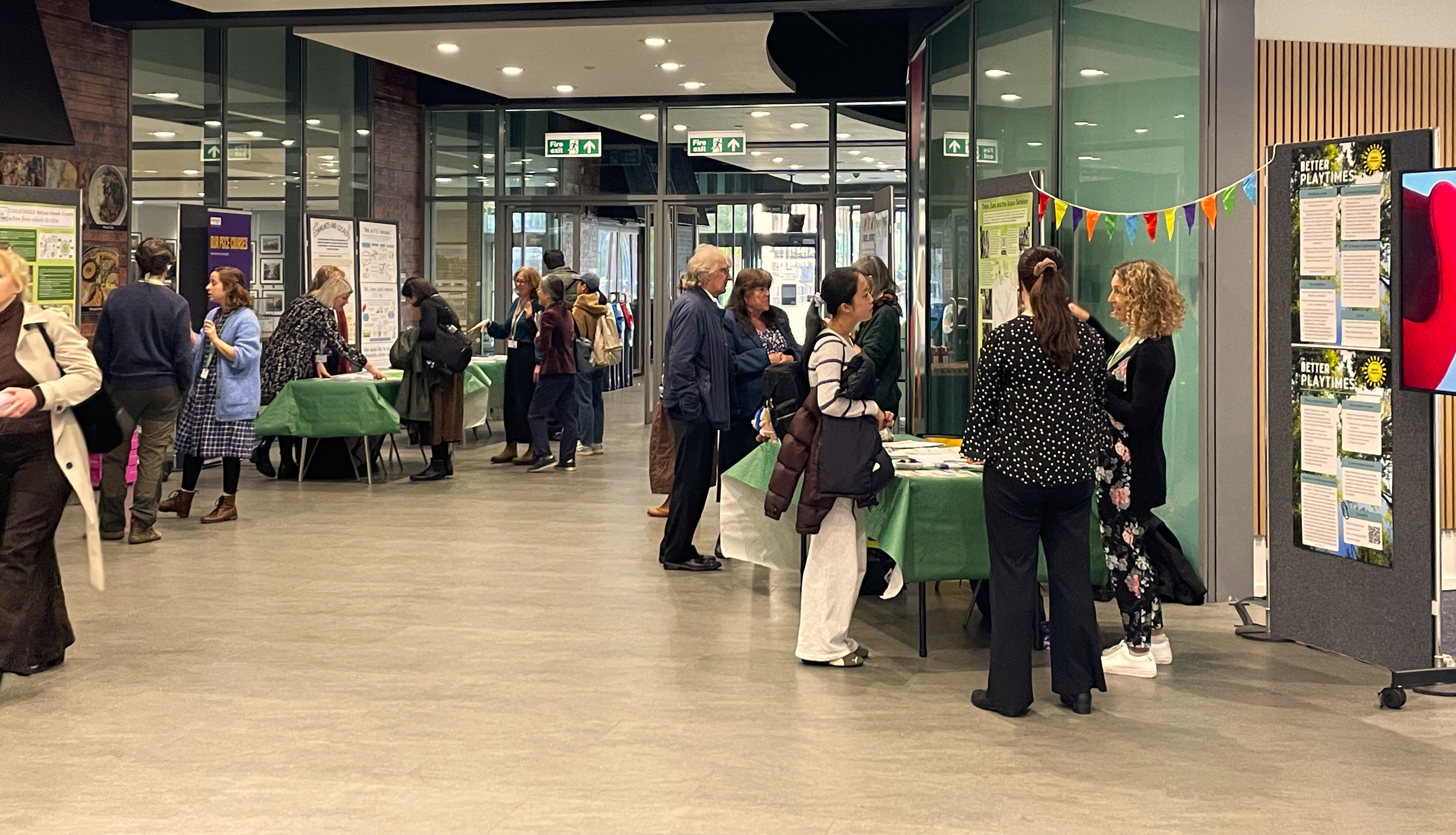
To fit busy schedules of local educators, policy makers and practitioners, we ran an in-person free-flow twilight exhibition (4–7pm). Attendees could drop in for 20 minutes, or 3 hours, and take their time to explore displays, watch videos, and pick up resources. The room buzzed with conversation—ideas sparking between case studies and unexpected connections.
Contributors to the exhibition ranged from environmental educators and policy groups to teacher trainers and psychologists. Their insights made the exhibition rich, practical, and inspiring. And together, the exhibition built a picture of how nature equity, wellbeing and physical activity can be woven into everyday spaces.
Acknowledging that not everyone could attend, we also launched an open-access virtual exhibit packed with tools and inspiration. Sharing the essence of the exhibition this online resource hub, offers tools and inspiration for anyone interested in how movement and nature can nurture wellbeing. Explore it here: https://lnkd.in/etF-4EuR
Contributor feedback
Our exhibitors told us how energising it felt to be part of this event—a space that celebrated creativity and collaboration. They loved turning research into practical ideas and sharing insights that connect with real-world challenges. Conversations flowed across sectors, from educators and youth practitioners to policy professionals, sparking dialogue and fresh thinking. Many said it was rewarding to see their work contribute to a collective effort for young people’s wellbeing and equity.
Contributors also embraced the inclusive ethos of our virtual exhibition. By sharing resources online, they extended the impact far beyond the room, making learning accessible to all. This reflects a shared belief: meaningful change happens when knowledge is open, collaborative, and available to everyone.
Why this matters now
Policy is shifting fast—from the National Play Commission to the School Sport and Enrichment Framework. Educators and decision-makers need solutions that are evidence-based, low-cost, and proven to work. We believe that this event—and its online hub—offers exactly that.
Final thought
The Active Lives, Natural Spaces event showed what is possible when practitioners, researchers, and policymakers come together: barriers fall, collaborations grow, and people leave feeling equipped to make change.
Active Lives, Natural Spaces was part of the ESRC Festival of Social Science 2025 and was made possible thanks to funding from the Economic and Social Research Council (ESRC), which is part of UK Research and Innovation (UKRI). The UKRI Economic and Social Research Council (ESRC) is part of UK Research and Innovation (UKRI), a non-departmental public body funded by a grant-in-aid from the UK government. It funds world-leading research, data and post-graduate training in the economic, behavioural, social and data sciences to understand people and the world around us.
Contact Us
+44 (0) 161 306 6000


0 Comments