
Imagining Our Working Lives: A Creative Exploration of Life-Courses and Work
The following report was written up and read by Clare Courtney, a Human Geography PhD student using her reflective notes taken during the workshop.
This event was part of the ESRC Festival of Social Science taking place over three weeks in October 2025 showcasing events that focus on our working lives, exploring the relationship between humans and digital technology. This workshop in particular invited us to engage with Dr Amy Barron and Prof. Sarah Marie Hall’s research exploring lives and life-courses in and around Greater Manchester, using creative techniques to explore people’s working lives. The aim was to share their approaches and findings by engaging with fun and informal methods such as story discussion, object interviews and postcards to the future. Members of the public were invited to take part in this interactive workshop, imagine their lives and where work fits into this.
Listen to the blog
We gathered in central Manchester in a large co-working space of a grade II listed former textile warehouse to hold our workshop on a crisp, bright Autumn Saturday afternoon. Meeting together were a group of postgraduate students, academic staff from across disciplines, visiting lecturers, and professional support staff from within Higher Education, all with an interest in work, life and everyday stories both in their work and/or studies.
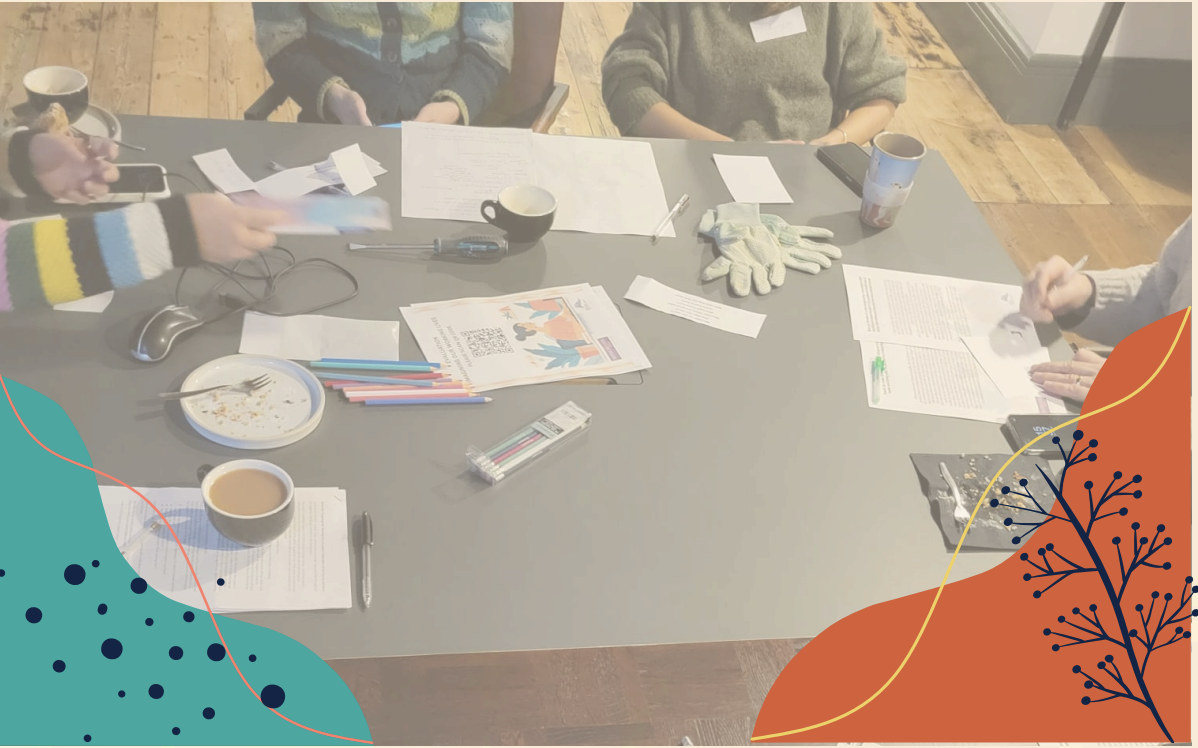
Over warming coffee, tea and delicious cake with blackberries and a sweet cinnamon crumble top, we came together in the space and relaxed into the comfortable chairs around a large table, sharing our introductions and connections to this workshop and its themes.
Amy and Sarah started the event off with an introduction to their research and current thinking on storying the life-course and work through creative life histories and their interest in sharing their approaches, methods and findings. They set their expectations and reasons for the event:
-
To share, specifically from a life-course perspective, their original findings and approach to work and life.
-
To deepen public awareness of life-course approaches, including the importance of thinking through experiences as life-courses rather than simply according to places or identities.
-
To inspire the public to engage with creative methods (as learners, participants, or audiences).
There was also the interest in bringing together people with layered and varied working lives to share, listen to and hear different perspectives of people’s life stories.
We then began the discussions around the original research interviews, which were presented to us in short vignettes, written down and then read out to the group. We listened together to the first story (one of Sarah’s research participants) Yusuf, whose interview brought up a lively and thoughtful discussion around nostalgia and imagined ideals of work. His narrative about his working life appeared to long for idealised work environments from the past, but, as some in the group noticed, this pointed toward imagined job security in the United Kingdom that may never have been. There was also resonance between some workshop participants and Yusuf’s own story of security and consistency (or lack of) in their working lives. This formed further reflections of the relationship between life disruptions and work disruptions.
The discussion flowed naturally with both Amy and Sarah sharing further insights into their research, the process which in turn led participants to extend this into their own thoughts about their work and studies. All these contributions helped the group to understand the importance of attempting to view work as part of a whole life, which a life course methodology could help to bring to the surface.
Amy’s research interview with Bea in the second vignette shared with the group helped to push the discussion into the effects gender and age may have on someone’s own framings of their story. It was pondered over whether the assumed trajectory of females lives led Bea to disclose from the start that she was unmarried, in her 50s with no children, and this led to further words around people’s selves and the stories told about them. Bea’s experience with stress and leaving her job formed the latter part of the discussion, critiquing the dominant biological and physiological model of work related stress.
This activity not only allowed Bea and Yusuf’s voices to be heard beyond the pages of research, and into the public arena for resonance and discussion, but it also helped participants, including myself, to really question the ‘fuzzy’ boundaries we have around work; what is work and what isn’t. This engaged the group in recognising the varied and layered intersections of individual people’s lives and work, and how we story these in practice (Barron, 2025).
Throughout the activities participants were allowed to freely refresh with drinks and cake, feeding into the gentle, caring and thoughtful organisations of the event.
For the next activity, we were faced with objects placed in front of us on the table: a pair of gloves, a bandage, a computer mouse and a wooden spoon amongst other everyday objects. Prompts about the objects were given on paper:
Who might use this object?
How might they use it?
What other objects is it stored with?
What might it have seen?
How is it put to work?
What value does this work have?
In small groups we interviewed each other about the object, a method inspired by Helen Homes’ (2020) method. A plenary discussion then summarised our reflections. There were observations on the physical properties of the object and the senses they evoked (the clicking of a mouse, the smooth natural feel of the wooden spoon), and consequent emotions and memories that arose from those memories. These intimate discussions then connected with broader themes around the objects having a role in work or in play, like the gardening gloves used for leisure, away from any expectation of ‘work’. With this activity, participants were able to get to know each other more. For example, in my group (the wooden spoon) conversations took place around home-making, cooking, the gendered role of food, the performativity of food and cooking. The academic discussions also led to personal sharing of advice and insights around food habits, the intersections with work and health and our daily routines. This exercise really highlighted for our group the different layers of knowing centred around an object, brought by people’s stories in response to clear and inquisitive prompts.
Rounding off our sharing of our working lives and Amy and Sarah’s research, we wrote postcards to ourselves in the future. Sarah guided us through this activity which she has used before in research with groups and individuals (Hall 2024 and Brooks et al. 2025). I write the prompt for the activity out in full here for full clarity:
We want to understand how you feel about work and the future, but we know that the future can be difficult to think and talk about, so this is where we can do an activity together instead. The purpose of this activity is to imagine what it would be like to communicate with someone like you in the future. This includes thinking about any advice you might like to offer them.
Using a blank postcard and a pencil, please write or draw a letter to a person like you in the future. Please ask yourself: What do you want to tell this person? If you were to give this person any advice on the things we’ve been talking about, particularly about work and lives, what would you say to them, and how would you feel? After you have written the letter, you will be asked to share, if you feel comfortable to do so, what you have written and who/what were you imagining when you wrote the letter.
The experience of this activity was varied, providing deep and thoughtful reflections on the process of creating. Many took to drawing, colouring and sketching alongside writing notes, others wrote personal letters to themselves, some used the space to imagine their work in the future. A strong thread of intergenerational work was clear here, with participants of different ages pondering how difficult this exercise would be if they were younger. This brought up some gentle learning around the perceived experiences of different ages. There was an interesting reflection by a couple of participants on the vulnerability of this exercise, some feeling like when asked to do an activity like this in the past, brought up feelings of self-consciousness and fear over being judged for them. This was really insightful and useful to hear for us all, and because this calm and open space had been nurtured from the start, participants felt freely able to share these comments and have them listened to. This final moment helped us all to recognise the importance of creating space for engaging with creative methods.
A gentle and enriching afternoon spent with an engaging group. I left with new ideas for creative methods, their process and the experience of trying them. As I cycled home, I also thought about the moments and stories that have provided me with a further understanding of the richness of people’s working lives and the potential for using creative methods and life-course approaches to deepen awareness of these complexities.
If you’re interested in running a similar event, access our guide:
Imagining our working lives: A guide to running your own creative life-course workshop
References
Barron, A. (2025). Making sense of ‘middle-age’: thinking from and through the middle. Social & Cultural Geography, 1–20. https://doi.org/10.1080/14649365.2025.2537686
Brooks, J., Hall, S. M., Astbury, J., Boulton, E., Hall, A., & Arnull, C. (2025). Healthy Ageing Futures for Older Women Asylum Seekers: Advancing Oral Histories and Futures Methods. International Journal of Qualitative Methods, 24, 16094069251371822.
Hall, S. M. (2024). Oral Histories and Futures: Researching crises across the life‐course and the life‐course of crises. Area, 56(1), e12904.
Holmes, H. (2020). Material relationships: Object interviews as a means of studying everyday life. In H. Holmes and S.M. Hall [Eds] Mundane methods: Innovation Ways to Research the Everyday Manchester: Manchester University Press (pp.66-83)
Contact Us
+44 (0) 161 306 6000


0 Comments