
From Classroom Concepts to City Streets: Learning about Peace and Conflict in Manchester
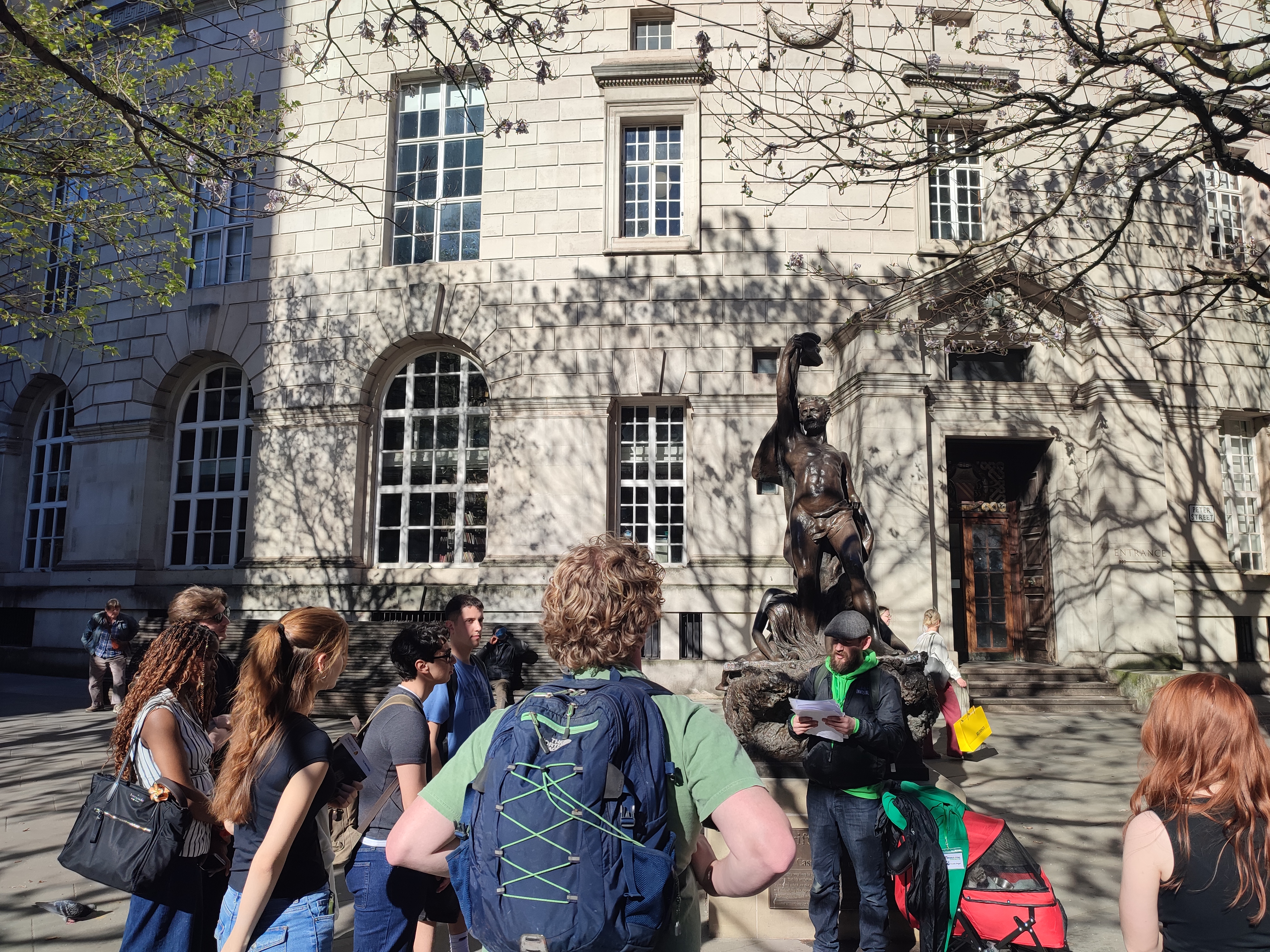
I was fortunate to take part in the Peace & Conflict Tour, organised by the module leader for POLI30262: Dimensions of Peace and Conflict in collaboration with Invisible Cities, alongside my fellow students on the module. It proved to be one of the most engaging and rewarding learning experiences I have had in Manchester. Learning about places in the city centre that I’d walked past countless times over the years without ever truly knowing their history gave me a completely different, deeper perspective on the city. From the cathedral to historic pubs, memorials and statues, each stop revealed how familiar spaces have been shaped by conflict, political movements and community responses over time.
 Moreover, what stood out most to me was getting to learn in more depth about significant events in the city’s history that I had previously only been aware of in passing, such as the IRA bombing and the Manchester Arena attack, but had never fully understood in terms of their wider impact on the city. Hearing how these events affected Manchester, particularly from our tour guides perspective as someone with lived experience and detailed knowledge of the city, helped me see how they shaped both everyday life at the time and the city’s longer-term response and recovery. It helped connect these events not just to the abstract ideas about conflict and peacebuilding that we had been learning, but to how they are understood and experienced within the city itself, which was particularly useful when thinking about the module’s focus on how societies experience and respond to violence. This was further reinforced by seeing how these events are remembered within Manchester today. Memorials placed within busy, everyday parts of the city highlighted how these moments remain present in the city’s identity, while also sitting alongside spaces that have continued to function and change over time. It encouraged me to think more critically about how public spaces preserve memories of conflict by seeing first hand how cities embed and maintain these histories in ways that are often easy to overlook.
Finally, what I found most valuable was being able to apply content from our module to real places in real life. The tour encouraged me to look at familiar streets and landmarks in the same way we’d been encouraged to throughout the module (by thinking about how conflict leaves lasting social and physical legacies and how public spaces shape the way those histories are remembered.) Seeing these ideas in practice made content we had covered, particularly anthropology and art, much easier to understand. It also gave me a perspective and practice that was massively useful when approaching my final essay where I had to apply these disciplines to evaluate real life, post conflict societies.
Overall, the tour was a great opportunity to take what I had learnt beyond the classroom and apply it in a real-world setting and I would love to have experienced more opportunities like this throughout my studies. It was not only massively enjoyable as an activity, but also very beneficial to my assessments and overall grasping of the modules content!
By Sophie O’Donnell, BSocSc(Hons) Politics & International Relations
Contact Us
+44 (0) 161 306 6000


0 Comments