
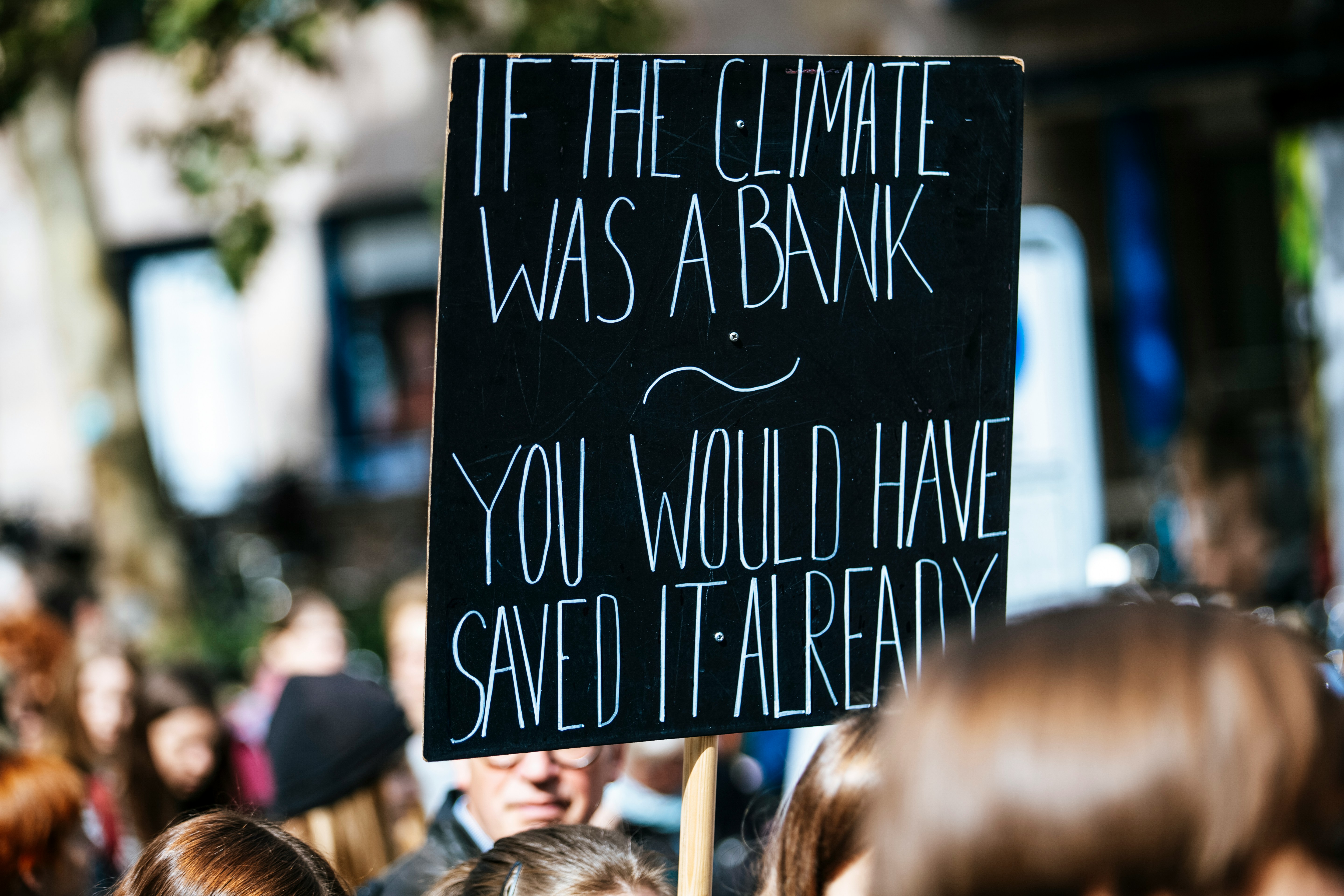
Capitalism and climate change: Is your consumption worth the cost of our planet?
Article by Evie-Jean Bartley
Photo by Markus Spiske on Unsplash
Many scholarly definitions of capitalism revolve around the idea of consumption, demanding constant growth. It is unsurprising then that our capitalist system is considered as the main cause of our ever-growing climate crisis. The uncontrolled desire for profit has led to the mass exploitation of our natural resources and destruction of ecologically sensitive landscapes whilst trapping people into a cycle of excess consumption that only exacerbates our environmental issues. It is not a stretch to say then that capitalism is committing genocide against the creatures of our planet. The journalist Naomi Klein, writes in her book Capitalism vs climate, “Our economic system and our planetary system are now at war. Or, more accurately, our economy is at war with many forms of life on earth, including human life”. Her writings highlight the need for change to our current system of production and overconsumption, though, this is undoubtedly a massive undertaking, and not all are receptive to a new or reformed capitalism.
The impacts that climate change has on society cannot be understated. Last year was the hottest year on record, creating droughts and floods in many parts of the world, displacing countless numbers. Extreme weather such as hurricanes Milton and Melissa has become more frequent. These deadly events are caused by increased greenhouse gasses in the atmosphere, with the burning of fossil fuels being largely responsible for this. These gasses then trap heat from solar radiation, enhancing the natural greenhouse effect, creating the man-made climate crisis we see today. So, if we know that the use of these fossil fuels is causing an environmental catastrophe, why do we continue to burn them?
The sociologist John Urry discusses in his analysis of capitalism and climate change how we are now locked into high ‘carbon pathways’ such as the large amounts of fossil fuels burned when people and goods move around the world within our capitalist system. These pathways are now ingrained into our society, creating a high carbon economy where hydrocarbons are involved in the production of many products and services. Historically, this was less of an issue as people only had the funds to meet their basic needs until the industrial revolution, with excess consumption being one of its consequences. Now, overconsumption has become a part of Western society, especially with the way media has evolved. Previously advertisements were just seen on television screens but now they are right in the palm of our hand. They are placed between every scroll on social media and pushed by influencers and celebrities alike, with the products promoted each having a carbon footprint, from creation to delivery, adding to global warming.
Urry not only discusses our consumption of products but also our consumption of places. In a globalized world we can seemingly visit anywhere, forging new relationships, travelling for new job opportunities, or simply going for a vacation. However, all of this comes at a high carbon cost. Mobility can also now be seen as a new symbol of class, with some becoming ‘connoisseurs of places’ to highlight both economic and cultural capital by taking part in the ‘experience economy’ to illustrate their higher class. Dubai is a clear example of this; a destination of luxury with 7-star hotels and projects such as the world islands, attracting 18 million tourists. Interestingly, the exploitation of the Indian workers and mammoth carbon emissions last year are kept quiet, hiding the ugly parts of this capitalist ‘utopia.’
But are we able to break this cycle of consumption? Urry calls this feat almost impossible, quoting Marx who calls capitalism “a genie that has been let out of the bottle that cannot be put back in”. These high carbon pathways and high consumption being too ingrained into our society to truly change. Furthermore, there are too many vested interests for change to come, with Klein discussing how “fossil fuel companies receive $775 billion to $1 trillion in annual global subsidies”, illustrating that in capitalism profit is king, and change is unlikely.
Ice caps will melt, and deserts expand, with millions of climate migrants forced from their homes, fleeing until there is nowhere left to go. This idea may sound like its plucked from a Hollywood disaster movie, yet for so many this has already become a reality and is set to become one for so many more if change does not come. It is tragedy that what should have revolutionised humanity could potentially be the cause of its destruction.
Contact us
+44 (0) 161 306 6000


0 Comments