
Climate, Capital, and Crisis
Article by Laurence Wright
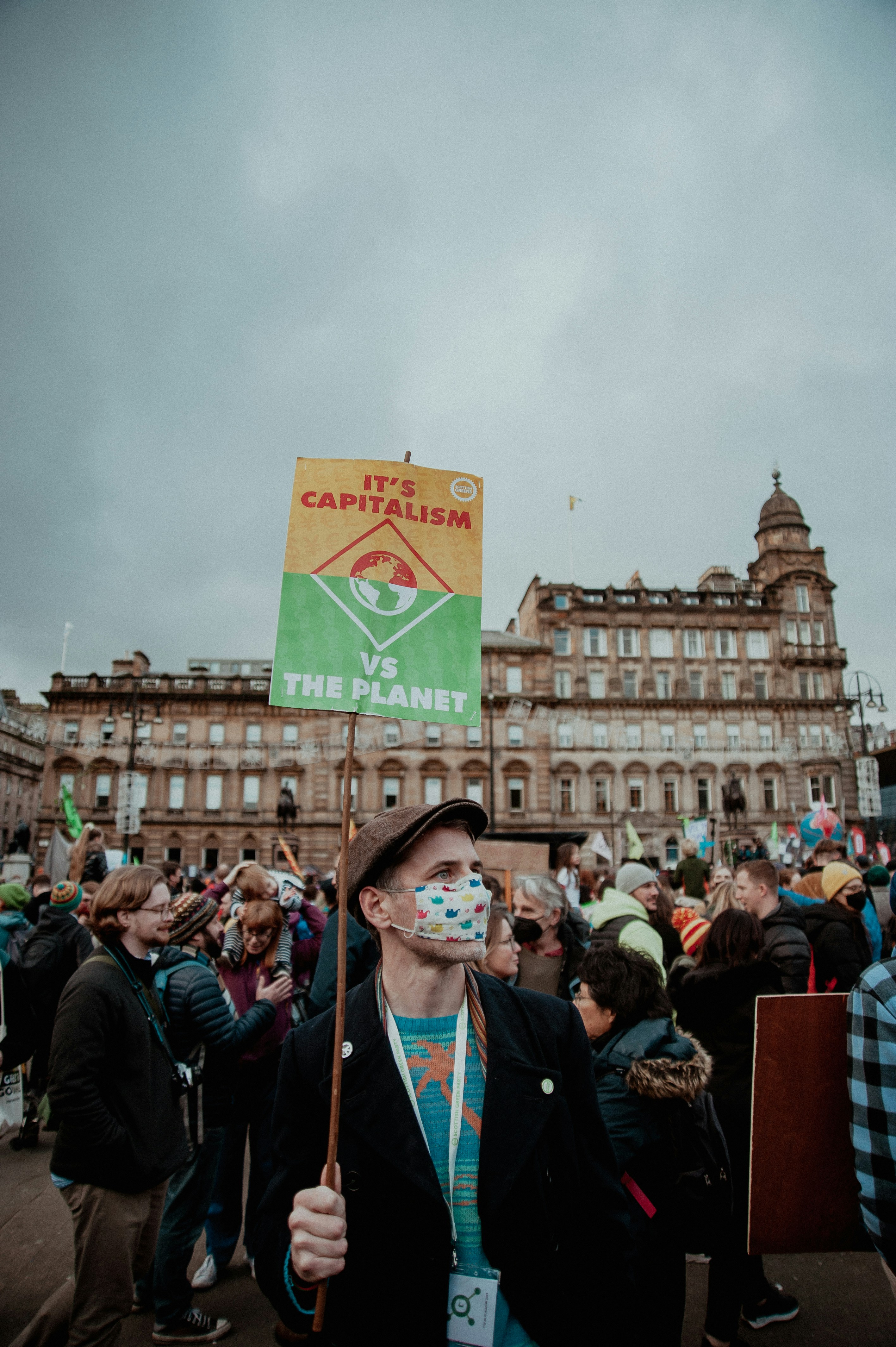
Photo by William Gibson on Unsplash
The continued expansion of the capitalist world-system is leading not just humanity, but the entire ecological order, towards disaster. Since the initial growth spurts of industrial capitalism in the nineteenth century, capital’s need for constant growth has forced all manner of environmental systems out of equilibrium and towards total collapse. 2023 marked the first year on record where average global temperatures exceeded 1.5 degrees above pre-industrial levels, the limit originally set by the United Nations and other international organisations beyond which climate breakdown would be unavoidable. Despite this, capital continues its assault on the environment unabated, with average emissions having risen substantially every decade since the birth of industrial capitalism.
At the root of capital’s ruinous effect on the climate is its fixation with growth. Sociologist John Urry (2009) returns to Marx to analogise capital as a sorcerer, which through its desire for power and growth has lost control of its “spells” and thus unleashed disaster: climate change. Urry (2009) sees environmental destruction as a core part of what he terms high carbon societies, driven in no small part by a transition from mere consumption to excess and overreach, and by modern society’s emphasis on mobility in particular. Hypermobility is certainly both a key characteristic of modern society and a key contributor to global heating, with the manifestly excessive distances travelled by not just people but products. Urry suggests that travel accounts for around 14% of carbon emissions: both the hypermobility of the Western upper and middle classes and the massive movement of goods belching out thousands of tons of greenhouse gases into the atmosphere.
There is perhaps an argument that Urry focuses in too far on mobility as a cause of the climate crisis, and in doing so loses the forest for the trees. The creation of the separate ‘zones of excess’ he views as a key driver of movement and source of the desire for mobility is perhaps not so much a result of some innate complex within the capitalist psyche as a question of economic efficiency. It is simply easier for the tourist industry to move their customers to concentrated areas than to provide amenities on a more even global footing, and this economic principle is when generalized a key factor in capitalism’s enormous climate impact. A globalised capitalist economy eventually finds that to concentrate certain industries in certain areas is extremely efficient for the generation of profit, and the corollary effect of massive emissions goes ignored due to its apparent irrelevance to short-term profit motives.
Industry is therefore concentrated in certain areas, typically with the least desirable and most destructive industries in areas historically disadvantaged by imperial destruction and extraction. A stark example of this is the business model of UK energy corporation Drax, which uses wood-burning biomass to generate power for rich parts of Britain. The necessary raw materials for this, however, are forests in areas of America primarily home to racialised communities still living with the economic legacies of slavery and segregation. The processing of these forests into wood pellets creates harmful carcinogens that affect these communities, which all the while see no benefit from the electricity created.
The separation of the globe into areas of imperial extraction and areas of consumption also has repercussions for the effects of climate change. It is not the capitalist class in the rich countries of the global North which will be the first to see the ruinous effects of climate breakdown, but rather vulnerable global South countries such as Bangladesh which have already borne the brunt of imperial extraction. As the climate crisis heightens these contradictions only become starker, and this fundamental injustice has enormous implications for the future of the capitalist economic model. As imperial exploitation of the periphery becomes more and more vulnerable to the direct effects of global heating, capital is faced with an existential challenge. To survive any longer it is forced to cannibalise itself, summoning more and more of Urry’s spells to contain those it has already released (2009). To contain and control the crisis is impossible within capital’s framework, and would require massive economic reform and the redistribution of resources globally to allow a more just, localised economy. But to do this would require capital to act against its basest instincts of growth and expansion, something it has time and again proven unable to do. The answer, then, must lie in the complete displacement of capital and its replacement with a liberatory economics: only then can the spells be forced back inside the bottle.
Reference:
Urry, J. (2009) ’, The Sociological Review, 57(s2): 84-100.
Contact us
+44 (0) 161 306 6000


0 Comments