
2024 ADH Book of the Year Award Interview
In this post, Professor Sasha Handley interviews Dr Beatriz Marín-Aguilera and Professor Stefan Hanß about their award-winning volume In-Between Textiles, 1400-1800: Weaving Subjectivities and Encounters (Amsterdam University Press, 2023).
Sasha Handley: Dear Beatriz and Stefan, huge congratulations on winning the 2024 Book of the Year Award of the Association of Dress Historians (ADH)!
ADH Deputy Chair Kirsten Burrall has stated that “the Awards Sub-Committee unanimously scored your book the highest across our rubric categories: new scholarship, under/misrepresented area, high-quality research and resources, and organization and clarity. Additionally, this book will appeal to our ADH members and readership and will undoubtedly contribute to the scholarship of our shared interests in the study of dress and textile histories.”
In addition, the volume has also been revealed as one of three finalists for the R.L. Shep Memorial Book Award of the Textile Society of America, which rewards exceptional scholarship that focuses on textiles in relation to cultural practices and ancestral heritage.
In your winning volume In-Between Textiles, 1400-1800: Weaving Subjectivities and Encounters (Amsterdam University Press, 2023), you bring together textile specialists from anthropology, archaeology, art history, conservation, curation, science, history, and applied arts. A wonderful feat in and of itself!
What inspired you to create such an innovative and interdisciplinary collection?
Beatriz Marín-Aguilera: We were both interested in the way textiles enacted power relations, shaped identities, and created in-between spaces for negotiation, resistance and rebellion, but we soon realised that there was only limited communication between curators, historians, weavers, archaeologists, anthropologists, conservators, and material scientists. Of course, there is cooperation at times, but most of the times each sector has discussed projects and outcomes with their respective peers, without wider cross-disciplinary collaboration, visibility and recognition. We think such conversation across boundaries is a necessary step forward, because we were—and continue to be—interdisciplinary ourselves, and thus we decided to embark on this very exciting and successful adventure.
Stefan Hanß: Personally, quite a few things have been inspiring from the very outset of the project: working together with Beatriz and field-shaping contributors across the world, and having worked now for years in institutional settings with inspiring colleagues that put innovative material culture approaches at the forefront of historical enquiries, and in particular the enthusiasm of my co-editor, Beatriz, for bringing disciplines together to generate new insights, pose new questions, push established answers and theories. Museum visits have been an integral part of the preparation and throughout the publication journey of this book, and I continue to be inspired—and frankly speaking absolutely stunned—about the worlds that a single thread can reveal.
As Beatriz has highlighted, the wish to see more cross-disciplinary exchange in conversations about historical textiles and the acknowledgement of the striking interdisciplinary potential of Textile Studies in general have been driving forces for us. The degree of specialist knowledge that exists in Textile Studies is simply breath-taking! We were curious to test the wider implications of such for a wide range of disciplines, and to see what happens if we develop a material methodology to examine global history. Working on this volume, to me, has shown that Textile Studies, in their interdisciplinary shape, can be positioned at the very forefront of material culture studies to push for new, innovative methodologies that advance a whole range of disciplines.

Sasha Handley: How did you both react when you heard that you had won such a prestigious prize?
Stefan Hanß: I was over the moon! The news was announced when I was in the middle of a snowstorm in Iceland, so I totally missed it first! When I then entered the warm hotel room and checked incoming emails, I was simply extremely grateful; such a humbling and rewarding experience to see this volume being read and recognised so widely, after years of exchange, enthusiasm, and energy across continents, languages, and disciplines.
Beatriz Marín-Aguilera: Well, we were of course totally amazed and absolutely thrilled when we were shortlisted for the two most important prizes on textile research in the world! There was a stiff competition because all shortlisted books are simply fascinating and field-changing, so when Kirsten Burrall—Deputy Chair of The Association of Dress Historians—contacted us to notify that our co-edited volume has been awarded the Association of Dress Historians 2024 Book of the Year we were beyond delighted! Despite the COVID-19 pandemic’s impact on all of us, we and our contributors put so much effort and work into this book, weaving all topics together to create this transdisciplinary tapestry. This prize is the recognition of all that teamwork.

Sasha Handley: Winning this award will undoubtedly mean that you gain new reading audiences for In-Between Textiles, but what is the key message that you would like your readers to take away with them?
Beatriz Marín-Aguilera: For me there are two key messages. The first one is that Europe—or the West—was not the centre, but the periphery of textile and material culture networks spinning since centuries before the ‘era of global encounters’. Indigenous and non-European textile techniques and practices changed the fabric of global society for ever. The second most-important point for me, quoting the great Suraiya Faroqhi, is that this book brings to the forefront ‘the agency of the excluded and allows historians to move away from glorifying metropolitan “culture” without a clear consciousness that it is a culture of imperialism’. This volume clearly demonstrates how by fleshing material culture, in this case textiles, the life and actions of ‘subaltern’ groups and individuals can be explored.
Stefan Hanß: Beatriz said it so eloquently that I hardly have anything to add here! Except, perhaps: Let’s all try to be a bit more open-minded in developing our methodologies and see what happens when we study the world past and present through a material lens… and let’s try to push a bit more how that material lens itself can look like, and what it can do… In the process of publishing this book, the intellectual journey itself has been deeply inspiring. Re-reading Bhabha’s Location of Culture – again and again, and again – after all those years, thirty years after its first publication, and engaging with the ways this book has reshaped humanities, as well as the existing critiques of it, has been simply a wonderful experience. I found it profoundly stimulating to think postcolonial theory in material terms, and vice versa. And I could not have wished for better companions on this intellectual journey.
Image credits:
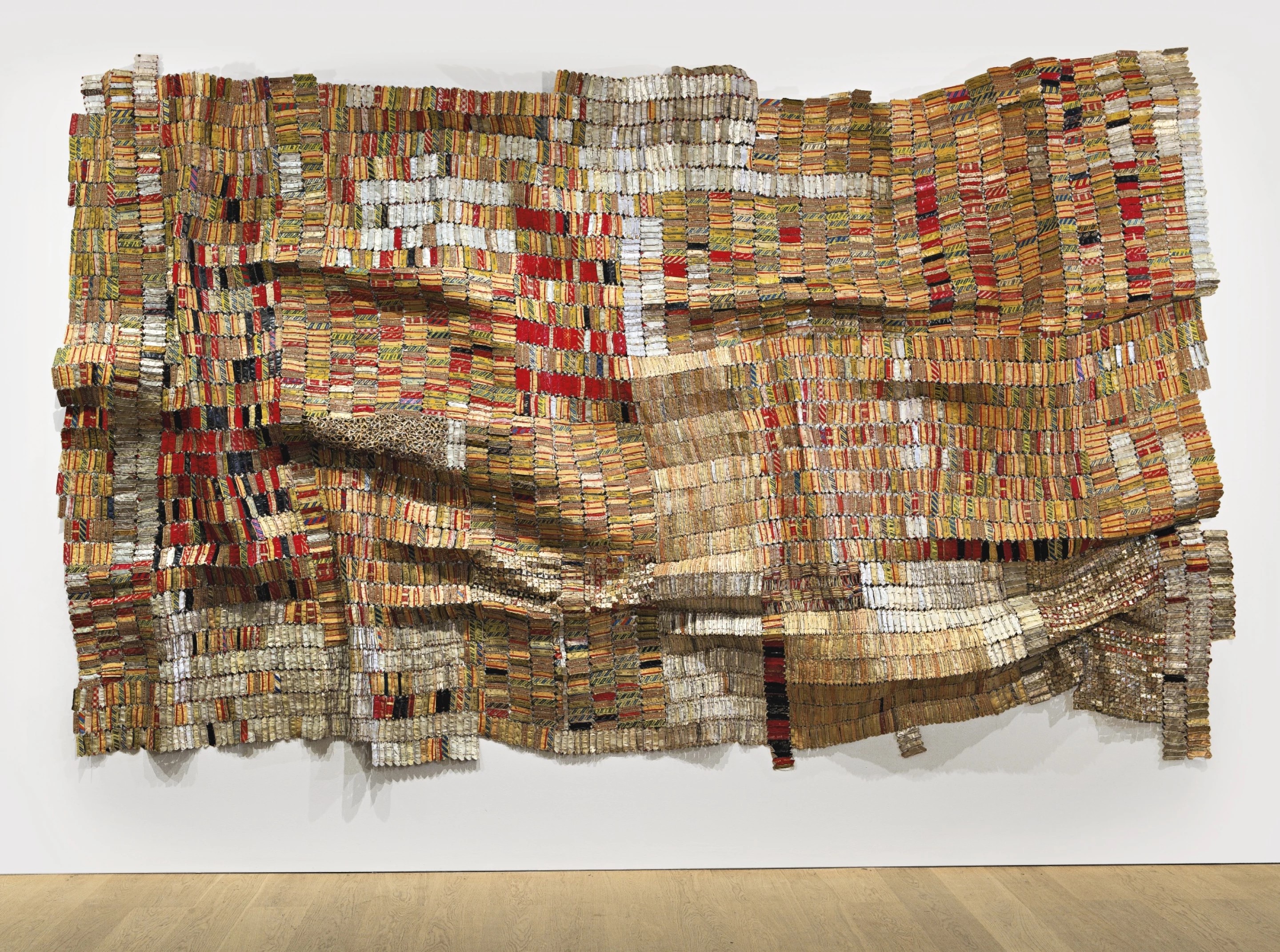
Fig. 1 (headline image): El Anatsui, Man’s Cloth II. Aluminum bottle caps, neckbands and copper wire. 274.3 by 449.6 by 22.9 cm. Executed in 2006. Image via Sotheby’s https://www.sothebys.com/en/auctions/ecatalogue/2014/contemporary-art-day-sale-n09222/lot.460.html (accessed May 2, 2025).
Fig. 2: Anon., Bankoku sōzu (萬國総圖), Nagasaki, 1671. Detail. © Bayerische Staatsbibliothek Munich, Cod.jap. 4.
Fig. 3: Cover of In-Between Textiles, 1400-1800: Weaving Subjectivities and Encounters (Amsterdam University Press, 2023), https://www.aup.nl/en/book/9789463729086/in-between-textiles-1400-1800.
Related
Related posts:
Contact Us
+44 (0) 161 306 6000


0 Comments