
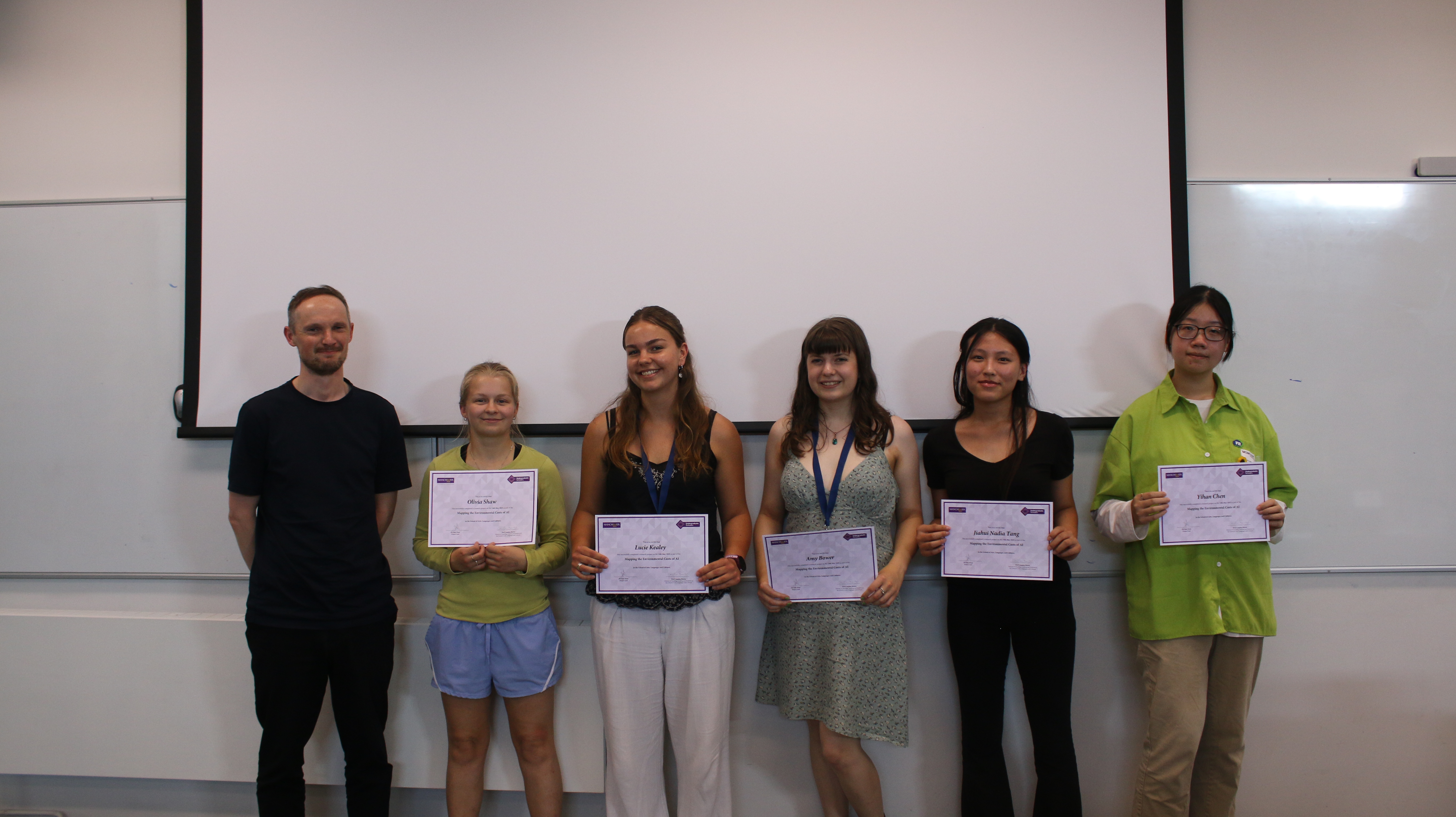
My UG Scholars Project: Mapping the Environmental Impacts of Artificial Intelligence
By Jiahui Tang
Did you know that exchanging 20 messages with ChatGPT equals 500ml of water? That might not sound a lot, but the training of ChatGPT3.5 before its first version came out consumed at least 3.5 million litres of water which equals to the daily consumption of water of around 25 thousand European citizens. 500ml of water might not sound much, but 3.5million litres sure is, which is the reason it is essential to understand the environmental impacts of artificial intelligence.
Our project was directed by Dr. Sam Hind, a lecturer of Digital Media, Culture & Society, who was interested in understanding the possible environmental impact of artificial intelligence (AI).
Our aim was to collect resources for the database, including academic papers, government and news media reporting, blog posts, research articles, etc.
We tried to quantify the impact of AI on the environment through the creation of a database: The Environmental Artificial Intelligence (EAI) Database. The database is an open and public resource collating various costs of different AI and ML firms, products and services like OpenAI’s now widely used ChatGPT.
Our project was inspired by other tech database initiatives like the AIAAIC Repository who collect incidents and controversies driven by and/or related to AI.
Why is our project important for SALC to research?
Living in a digitalized world means we often use digital tools that use AI, for instance the widely used ChatGPT. AI surely is revolutionary, however we need to consider its environmental impacts. AI data centers consume large quantities of water to cool their computers from the heat generated. AI training uses huge amounts of energy, and much of this energy comes from unsustainable sources associated with greenhouse gas emissions. Besides consuming large amounts of energy and water, AI systems rely on physical machinery, including computer chips, processors and power systems, which often are not being recycled and go to landfill.
It is essential to research the impact of AI on our environment. Future SALC students interested in the environment and/or AI should join this research project to create a resource for future researchers and scholars.

Related
Contact Us
+44 (0) 161 306 6000


0 Comments