

Deep dive with an electricity generating company: qualitative insights from site-based workers.
This study forms part of the wider PROTECT National Core Study on COVID-19 transmission, and sought to explore COVID-19 transmission within the nuclear energy company, EDF. The focus of the study, led by theme 3 researchers of the PROTECT NCS, was to explore worker’s...

An exploration of how ‘Living with COVID’ influences COVID-19 transmission risk, response and resilience in workplace settings: a Greater Manchester Case Study – Study 2
The Greater Manchester Case Study investigated how changes in policy and advice, as set out in the government report ‘Living with COVID’, affected COVID-19 transmission risk, response and resilience in workplace settings. This study, study 2, used qualitative...

SARS-CoV-2 detected on exhaled breath by facemask sampling predicts how likely someone is to transmit to their household better than upper respiratory tract swabs.
People who test positive for COVID-19 and breathe out virus are more likely to infect their household members than via virus sampled in their nose and throatPeople are most likely to breathe out high amounts of virus early on when they are infectedIf participants were...

Importance of ventilation as a means of infection control in care homes.
As winter continues and energy costs rise, it is tempting to try and keep residents warm and fuel costs down by hunkering down until the weather gets warmer. But keeping all the windows and doors shut may not be the best idea: all homes need ventilation and care homes...

Keeping the UK Building Safely phase 2 report
This Keeping the UK Building Safely (KUBS) report is part of the PROTECT National Core study, and explores four themes: transmission risk and perceptions, safety leadership, transmission modelling and wider project delivery and contractual performance in the context...

Knowledge share workshop with PROTECT researchers: consolidating similarities and differences in findings from sector specific research.
When it comes to controlling workplace transmission of SARS‑CoV‑2, the virus that causes COVID-19, different workplace sectors face different challenges, both in terms of likely transmission routes and which control measures can be practically and effectively...

Occupational differences in COVID-19 incidence, severity, and mortality in the United Kingdom: available data and framework for analyses
This methods paper, produced by researchers from Theme 3 of the PROTECT study, assesses the datasets available for investigating difference in COVID-19 mortality for workers in different occupations in the UK.All the datasets considered are found to have particular...
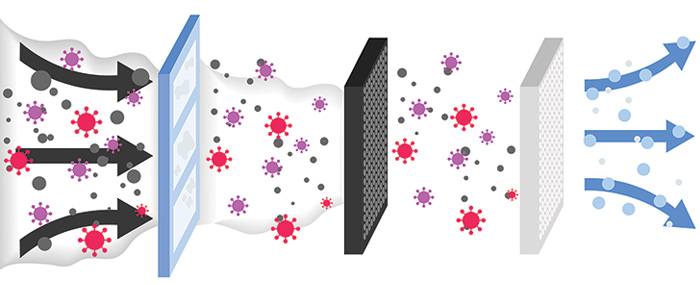
Room-Based Assessment of Mobile Air Cleaning Devices Using a Bioaerosol Challenge
The widespread transmission of the SARS-CoV-2 virus has increased scientific and societal interest in air cleaning technologies, and their potential to mitigate the airborne spread of microorganisms. In this paper, published in Applied Biosafety, researchers from...
Exploring the relationship between job characteristics and infection: Application of a COVID-19 Job Exposure Matrix to SARS-CoV-2 infection data in the United Kingdom
The COVID-19 Job Exposure Matrix (JEM), has been developed to categorise occupations according to workplace factors believed to be associated with SARS-CoV-2 infection, the virus that causes COVID-19. This paper, published by Theme 3 researchers of the the PROTECT...
Contact Us
Email: PROTECT@hse.gov.uk
Health & Safety Executive – Science Division
Harpur Hill
Buxton
SK17 9JN
Connect with us


Recent Comments