

How much ventilation is required to reduce transmission?
Although there is no “safe” ventilation rate to prevent the spread of pathogens altogether, ventilation that maintains lower CO2 levels (under 800ppm) is considered a lower risk environment. High CO2 levels (routinely above 1500ppm) are often a sign of poor...
How can I help ensure rooms are ventilated properly?
If you are responsible for managing workplace buildings, it would be useful to provide information about how rooms are ventilated, and reassurance around how systems are checked and maintained. Surveys of employees and business owners carried out during the PROTECT...
What are the minimum specifications required?
While there are no specifications for infection control, there are principles you can follow to reduce risks:Ensuring that the system provides sufficient fresh air ventilation for the occupants.Ensuring that the system is regularly maintained and that there is a...
Which types of ventilation are most effective?
Some mechanical ventilation systems recirculate part of the air in the room. This can increase risks of exposure to respiratory viruses unless the system has devices to remove pathogens such as high-grade filters or UV light. Related Contact...
What is the difference between ventilation and air conditioning?
Ventilation is not the same as air conditioning. In some buildings mechanical ventilation systems also provide heat and cooling, but in others stand-alone air-conditioning units are installed to cool the air – these are very common in offices and hospitality...
How important is ventilation?
Good ventilation can significantly reduce the risk of exposure to airborne virus particles, providing there is enough fresh air flow or good filtration.There is evidence from Covid-19 outbreak studies that in buildings with better ventilation, infection rates are...

How likely is it for respiratory virus transmission to occur via surfaces?
Transmission via surfaces is possible but it is likely to account for a relatively small proportion of transmission for Covid-19. When measured in the vicinity of an infected person it has been possible in a very small number of studies to find live virus on a...
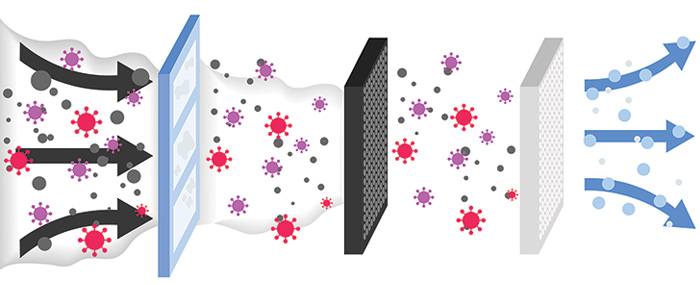
Are anti-viral air cleaners with UV technologies effective at reducing transmission?
Air cleaning devices using UV-C technologies are likely to be beneficial for reducing transmission risk. Enclosed devices work in a similar way to HEPA filters, and you can choose which type of device is right based on the same principles.We have known for decades...
How effective is fogging in reducing the risk of virus transmission?
A fogger is any device that creates "fog", or very fine mist, from a liquid. They are typically filled with disinfectants.There is no evidence that foggers are useful in a room with people present, and they may cause harm.Fogging devices may have some use for cleaning...
What type of space are HEPA filters most effective in?
They are more effective in rooms where the ventilation rate is lower than desired and/or is difficult to provide ventilation consistently. This can include rooms that rely on opening windows for ventilation.There are a range of different options, including portable...
Contact Us
Email: PROTECT@hse.gov.uk
Health & Safety Executive – Science Division
Harpur Hill
Buxton
SK17 9JN
Connect with us


Recent Comments